HAZAL GÖÇMEN: You often highlight the importance of “class composition.” How does the workers’ inquiry approach help us analyze wildcat strikes—especially in authoritarian labour regimes?
JAMIE WOODCOCK: This is an interesting question. For me, the idea of workers’ inquiry is fundamentally about understanding how the production of knowledge—thinking about and discussing our working conditions—can also be part of a process of organization.
As a researcher, I recognize that many people are already aware of their working conditions, simply because they have to go to work every day. All workers engage in some aspect of this process; you have to understand how your work is organized to do so. The first day at work is always a process of figuring out who you report to, what your tasks are, and how people find ways to make the work easier, and so on.
Therefore, inquiry is not a strict methodology with very specific methods or a rigid order of operations. Instead, I think of it as an approach to how those of us outside the workplace can conduct research with workers, or how workers can do research themselves. In understanding the dynamics of wildcat strike action, research often starts with the union and works backward from there. What is useful about inquiry is that it starts with the workers and their experiences. This makes it easier to understand why wildcat strikes often appear as the first public moment of resistance. It helps us understand how and why they happen and what workers are trying to achieve, providing a broader understanding of the strike itself.
When you’re doing inquiry—especially worker writing—what changes when people are finally given space to talk about their work? How does that turn recognition into the first steps of organizing?
I have been involved in various inquiry projects, specifically with Notes from Below.[1] When we have done worker writing projects, the first thing most workers ask is: “Why would anyone want to read about my work?”
It is common for no one to ask them about their work or to give them a space to discuss their problems and potential solutions. A primary aim of these inquiries is to take people’s experiences seriously and to understand how they make sense of their work individually and collectively. In a way, this is the “pre-organizing” question.
If you want to change your conditions, you first need to understand what those conditions are. There is always an element of this in struggle; you have to understand what you want to change and what is possible to change it to. As someone outside the workplace, I do not go to a group of workers to tell them how to organize. I don’t know the best way for them to do that. However, opening up a space where people can talk about and make sense of their experience can be part of the organizing process. It also allows other workers to say, “I recognize that. I’m facing something similar, and I can learn from what they’ve done.”
But taking that first step doesn’t always lead to a win. When things don’t work out, people often say, “We tried—and we lost. So why try again?” What helps keep people going after a defeat?
This is always one of the difficult lessons of organizing. We often think that if we organize, we will win something small, then something bigger, and so on. In reality, a common experience is trying something and failing.
This is a difficult lesson to learn; we learn a lot from negative experiences.
The challenge is whether we have the time and space to reflect and learn a useful lesson. You could take the lesson that “it wasn’t worth trying,” or you could ask, “Why did this go wrong? What could we do differently?”
In Notes from Below, we have told stories of organizing that didn’t work, from campaigns that failed for one reason or another. However, there is also immense value in telling the stories that do work. This is about the circulation of knowledge. Often, one group of workers may not know that another group has successfully organized because these stories are difficult to share. This is an interesting question since the labour movement in most countries is not currently experiencing a surplus of successes. The challenge is: how do we keep going even when we aren’t winning, and how do we highlight examples that we can point to?
That’s the difficult side of organizing—what happens when you don’t win. But in the UK we’ve also seen a major strike wave in recent years, across rail, health, and education. From what you’ve seen, did that change the relationship between workers and their unions?
A bit of context should be given to understand this question. To provide some context: In Britain, we have one main Trade Union Federation (TUC), which represents the established labour movement. Then we have a newer part of the movement—smaller independent unions like the Independent Workers’ Union of Great Britain (IWGB) and United Voices of the World (UVW)—that emerged partly due to the limitations of the existing labour movement, particularly in organising migrant workers or those in outsourcing and the gig economy. While influential and with many success stories, this alternative sector is still relatively small.
The mainstream labour movement had gone through a long period of decline and failure. However, we recently saw a series of large public-sector strikes in Britain, triggered by the highest inflation in my lifetime. In part, these strikes occurred not because the trade union leadership wanted them, but because they had no choice; members were feeling the cost-of-living crisis acutely. They were, in that sense, reluctant strikes.
When you have a big strike—at one point we had almost a million workers on strike, including railway workers, public sector workers, big healthcare strikes, teachers, and academics—that opens up the possibility for rank-and-file organising and new leadership to emerge. This has rejuvenated bits of the labour movement by putting strike action back into the popular consciousness. For example, doctors have been on strike quite regularly and won significant pay rises.
And inside unions, did anything shift? Where did you see participation grow, or internal democracy get stronger—any examples that really stood out?
Yes, this has happened particularly in the Doctors’ Union (BMA). It is a very old union, a hundred years old, that also functions as a professional body and was historically not very democratic. During the strikes, a younger cohort of doctors became involved, revitalizing its internal democracy. The railway workers’ union (RMT), on the other hand, is already much more democratic with a longer history of participation.
In other unions, such as my own (UCU – Academic Workers Union), when strikes occur, people get excited and want to participate, often encountering the limits of union structures. This friction opens up a space for new organizing.
That’s inside established unions. But a lot of the most exploited workers sit outside those structures altogether—especially insecure and migrant workers. In your view, what tends to be the tipping point? What helps people move from fear and isolation to acting together?
This is the central question for the labour movement: What overcomes the fear of losing one’s job and livelihood?
This is a question I think about often. This is the question in the labour movement. At Notes from Below, we argue that there is nothing automatic about bad conditions leading to organizing. We try to do so in different sectors. If that were the case, there would be much more organizing globally. We try to analyze the technical details: how are people managed? How are they exploited? How is insecurity organized? To think about what kinds of responses workers could have collectively. The challenge is that it can be subjective.
While the tipping point is subjective and differs by sector, there is a lesson from Marx that remains true: work pushes us into networks and communities with other workers who share our conditions. The one thing workers always do when together is complain about the work. Finding commonality and forms of solidarity. This still happens, even in the most precarious jobs. That is the building block for any kind of organization. In those moments, people come together.
The most effective campaigns take that seriously rather than saying, “You’re precarious, join the union, we’ll fix it for you.” This does not work. People must have control over their own organizing. The difficulty is that the most precarious forms of work, and the most exploited sectors, face genuine barriers to organizing, access to meeting places, resources to communicate strike funds, and so on. I face in my own work. What do you do as a secure worker, part of the labour movement, who can support precarious workers? Both sides benefit from solidarity.
Once that first collective step happens, how does it spread? What helps a small workplace fight connect with something wider—other workplaces, other sectors, the broader labor movement—instead of staying isolated?
A significant difficulty lies in the labour movement’s current fragility, which often forces activities to concentrate on individual support. Most British unions, for instance, are frequently swamped by managing individual casework and dealing with issues on a one-by-one basis. While it’s easy to suggest that this individual work should be undertaken collectively, moving from this ideal to reality presents a considerable challenge.
In Britain, we have been involved in a project called Organize Now, which connects people who are not in the labour movement or unions with someone in the labour movement for advice on taking collective action. For us, this project is interesting because unorganized people can access advice. Most people in Britain (and likely in Turkey) are not in unions and don’t know anyone who is. Some advice would be helpful. People in the labour movement, maybe in more secured jobs, established unions arguing with the employers, talk to people who are not organized. Both sides benefit. Separation within the broader working class: those in unions are those who are not.
This project allows established union members to talk to unorganized workers, reminding them of what it’s like to take those first steps. It helps bridge the gap between the organized and unorganized parts of the working class.
Have you seen similar efforts elsewhere, and what tends to work—or fail—in practice? Would you consider initiatives like this as forms of counter-hegemony within the labor movement?
Absolutely. It is remarkable in Britain how popular the big strikes have been, despite a concerted media effort to portray them negatively. There is a constant ideological attack on unions. There is a challenge in bridging the gap between organized and unorganized workers, which is difficult, especially since many unions still organize on a sectional basis (by profession or sector). Which raises the challenge of how to bring people with quite different work experiences together. Opening up spaces for exchanges between different types of workers is one way to challenge that separation.
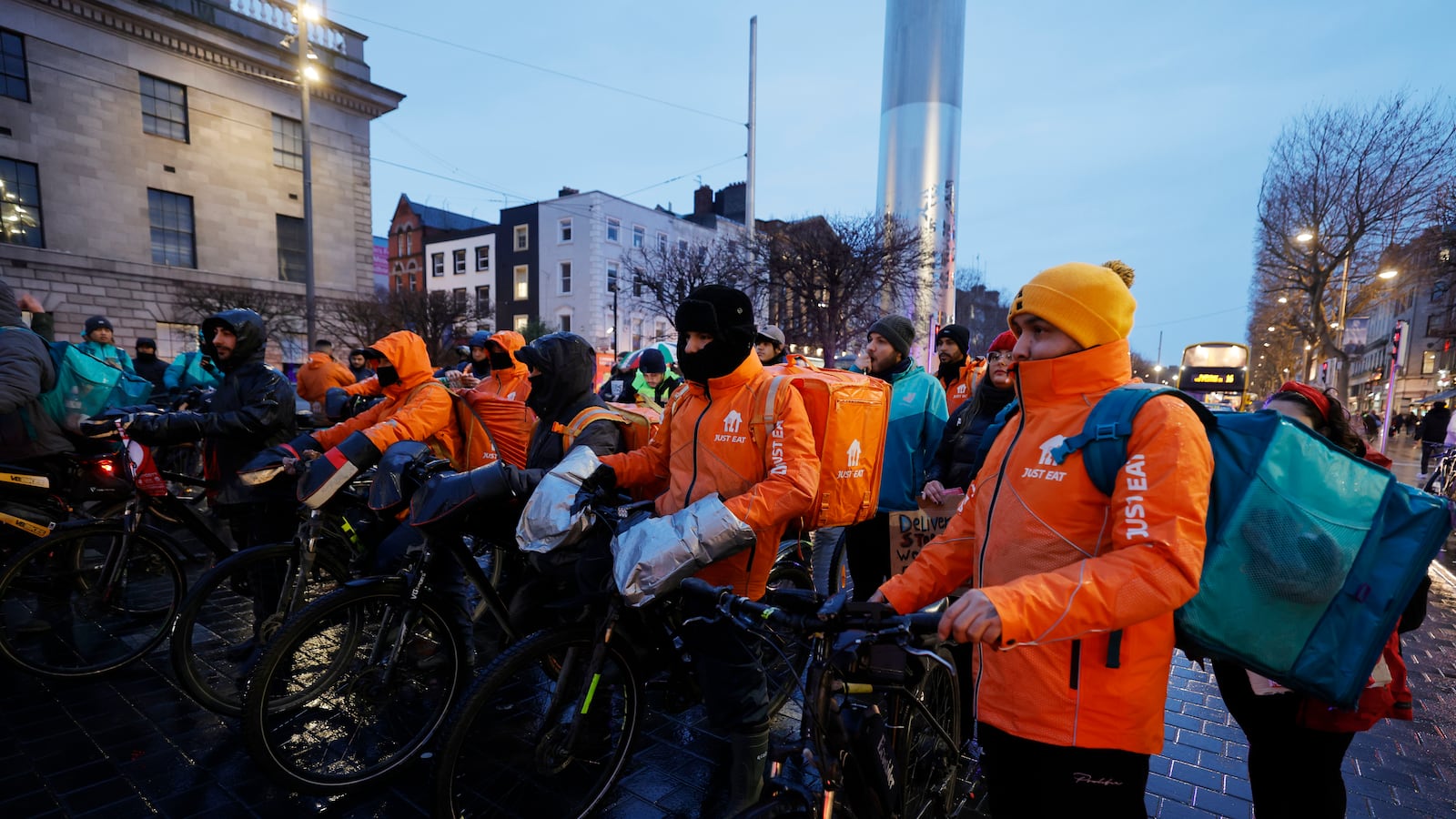
That divide you’re describing—between organized and unorganized workers—seems especially sharp in platform work. You’ve written a lot about the gig economy. Do platforms try to keep the labour process out of sight for consumers, so it feels like you press a button and the service just “appears”? And when workers break that invisibility—through courier strikes, street protests, or actions in places like Amazon warehouses—what changes? What makes those moments of visibility matter for building wider connections in the labour movement?
Some parts of the gig economy rely on the Silicon Valley dream of invisibility—you press a button, and food appears. The labour involved in warehouse work, data labeling, or content moderation is often hidden. However, other parts, like taxi driving or food delivery, are quite visible.
In Britain, with platforms like Deliveroo and Uber, the illusion has shattered. Nobody thinks these are good jobs with good conditions anymore. Because their workplace is the street, their resistance—strikes and protests—becomes highly visible.
The question of visibility is really about subjectivity: How do workers understand their position in the working class? A hospital cleaner has more in common with a food delivery driver than they might think. Recognizing that commonality is the start of building connections.
If that kind of recognition is where connections begin, what happens under authoritarian labor regimes—where obedience is enforced and speaking up can feel impossible? To close, what does being a “troublemaker” actually mean in practice, and how can it feed into a wider fight for democracy beyond the workplace?
For those not in a union, questioning a boss’s decision can feel impossible. Most workplaces are incredibly undemocratic. In the book I wrote with Lydia Hughes, we discuss the idea of the “troublemaker.” We are told to keep our heads down, but for most workers, simple obedience is no way to survive because wages are insufficient. We need to reclaim the idea that everything we have—holidays, pay rates—exists because someone was a “troublemaker” in the past.
The rise of new authoritarian politics globally is about enforcing obedience. As the far-right captures parts of the state, it can feel paralyzing. We argue that the fight for democracy in the workplace is central to building a fight for democracy in society. If you cannot have control over your own work, how can you have control over your local or national government?
We need to build class power. You don’t have to be an expert or a famous figure to be part of that struggle. You just have to be someone trying to organize at work with the people you work with. That is part of the wider fight for democracy.
Jamie Woodcock is a Senior Lecturer in Digital Economy at King’s College London. His research is inspired by the workers’ inquiry method and focuses on labour, the gig economy, platforms, resistance, and videogames. He is the author of several books, including Troublemaking (Verso, 2023), The Fight Against Platform Capitalism (University of Westminster Press, 2021), The Gig Economy (Polity, 2019), Marx at the Arcade (Haymarket, 2019), and Working the Phones (Pluto, 2017). He serves on the editorial boards of Notes from Below and Historical Materialism.
[1] Notes from Below is a publication committed to socialism, defined as the self-emancipation of the working class from capitalism and the state. To this end, it employs the method of workers’ inquiry. Its written contributions are categorized into three types: “Inquiry,” which involves original research into class composition; “Bulletins,” written for and by workers and militants; and “Theory,” which offers perspectives on working-class struggle drawn from advanced theoretical debates, or analyses of the historical co-development of class struggle and capitalist exploitation.