ULAŞ TAŞTEKİN: Let’s begin with the issue of “authoritarian labor regimes.” In the literature, this term overlaps with several related concepts that describe similar dynamics. In Turkey, a group of us has been using “authoritarian labor regime” as a working label, but we do so cautiously, since a systematic conceptualization and framework is still underdeveloped. In your work—especially Southern Insurgency—you examine these dynamics by linking labor regimes to contentious forms of worker struggle. I approached a similar set of questions in my MA thesis on the 2015 wildcat strikes in Turkey’s automotive industry. That research pushed me to think more broadly about the relocation of production to the Global South and the changing composition of the working class—both within the Global South and at a global scale. What should we highlight about these transformations, and how can we briefly situate this background?
IMMANUEL NESS: Well, there’s a long history of relocation of production from affluent regions to the periphery. First, within the center of the world economy, and second, beyond the center to regional locations like Turkey, and then other locations on the periphery with even lower wages. This has been facilitated by advances in logistical capacity over the last 50 years or so. Now production can take place anywhere on the planet, and certainly under neoliberalism, that has become a major facet.
We now have a global division of labor, and reserve armies of labor in the countries of destination. The growing reserve army of labor allows neoliberal capitalist production regimes: international capital and pivotally, nation-states to work together in a pernicious way toward workers who compose most of the global economy. China is an exception to the pattern of degradation of labor.
The reserve army of labor facilitates internal migration in countries like India, Bangladesh, Pakistan, Indonesia, Egypt. On the periphery, workers are primarily internal migrants from the countryside to major urban centers. This has taken place throughout the Global South: a pattern that also has occurred in Turkey, though the latter is considered a middle-income country by the World Bank and OECD. The commodification of agriculture in a number of countries of the South forces people into rapidly enlarging urban areas to survive. This precise migratory process allows peripheral countries, corporations, and ultimately Western capital, to exploit labor to a great degree.
We must be careful to distinguish government policies in the Third World. Different characteristics exist, and not all the countries practice authoritarian capitalist policies. Most certainly, this is true China, where any worker has the government right to return to their hometowns where they can survive through agriculture. Moreover, the Chinese state has moved well beyond the West through its labor unions who are responsible to all workers, not just those in trade unions.

We’ll come back to China in more detail later. But before we do, I’d like to broaden the discussion on authoritarian labor regimes. If we expand the debate: the capitalist mode of production, in terms of its approach to labor, has always had an authoritarian logic. I’m trying to draw attention to its underlying nature—how it turns the worker into an input to production by stripping away their human dimension. When we look at Engels’ The Condition of the Working Class in England or Marx’s Capital, especially Volume I, we can see many examples of this reduction of workers to production inputs. In that sense, it is not specific to the neoliberal era.
At the same time, workers’ struggles—whether in the wake of the October Revolution or alongside the rise of Western social democracy—did reshape labor rights in important ways. What seems distinctive over the last four decades is the global diffusion and intensification of mechanisms that discipline labor: suppressing workers’ power to make economies more attractive to foreign investors and to smooth capital accumulation.
So what I’m asking is not whether capitalism was ever “non-authoritarian,” but whether “authoritarian labor regime” is a useful way to describe the particular configuration that has emerged since the 1980s—and how it connects to the kinds of contentious labor mobilization we see today.
Yes—very important points. To sustain neoliberalism, an authoritarian neoliberal regime is a prerequisite. Or, alternatively, nations must give worker rights through labor regimes that are highly efficient and treat workers well. Of course, only a few countries are transitional socialist states on this path.
But yes, I agree with your main point. There is a precise reason for expanded investment on the periphery of the global economy, or the Global South, if you prefer. It is precisely because they have labor regimes that can extract higher surplus value from workers and sell very cheaply on the global markets. Productivity is advanced either through super-exploitation of labor under conditions with limited capital subsumption or in states that invest in technology to apply to industry, in which case, skilled workers are more productive.
In this context, we must understand unequal exchange through international trade between wealthy and poor countries. If Marx were to have written a fourth volume of Capital, it would have been precisely on the question of the imperialism of trade that exploitation lies. Marx and Engels were moving toward a distinction of the working class in the core of the world economy as increasingly privileged, and that trade unionism there could become highly nationalistic. I will add a caveat: in all countries workers are exploited by capital. The question is where exploitation is the most.
For instance, in the preface to the second edition of The Condition of the Working Class in England in 1844, published in 1892, Engels advances the claim that not all workers are precisely the same. Levels of exploitation of labor vary between Europe and the core of the world economy to peripheral regions, which at that time were mostly under colonial domination. Engels discusses how the working class in the core had become increasingly nationalistic and privileged, and in a sense being bribed by capitalists to accept a system of inequality in the world economy, which inures to the benefit of labor in the core.
Engels makes that point, and so does Lenin some 25 years later in 1916. He uses the term “bribe,” and claims that it takes place essentially within the trade unions themselves.
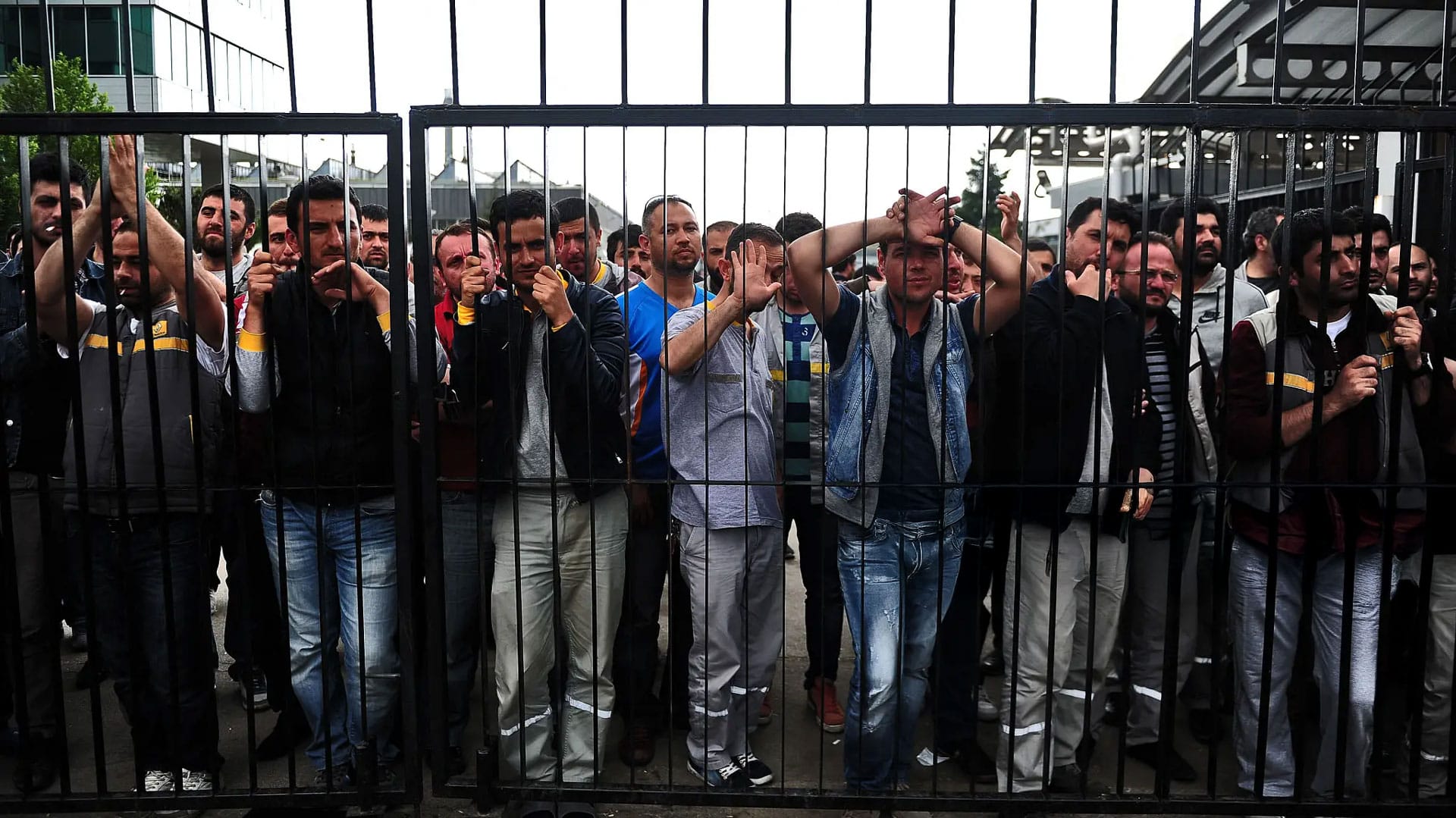
Now, of course, workers need trade unions. They are essential to protecting the interests of all working classes. Even in socialist transitional economies, trade unions are necessary to represent the democratic interests of workers. But in highly exploitative countries like India, you will find an authoritarian labor regime without question. Workers do not have a say about wages and working conditions that are dangerous and exploitative. If they go on strike, they will be crushed by police with the support of leaders of both major political parties.
India is a strong case. We’re talking about a country of just over 1.4 billion people. The vast majority of the working class are not in labor unions. Many labor cheerleaders take solace in the mass strikes once or twice every year. But those strikes are considered by most workers as a day off from work rather than a strike against capital, which factors “strikes” as days off from work.
And if one examines a factory producing automobiles for a foreign multinational firm, one might see 1,000 workers in the plant, but perhaps only 10 to 15 percent are counted as the “real” or permanent workers. So if you have 5,000, perhaps only 500 can negotiate contracts through a labor union. That is part of the system.
Also, the Westminster-style system of government and the forms of trade unions that formed and exist in the West have been implanted in many countries of Africa, Asia, and Latin America.
To move beyond authoritarianism, the working classes require a new political regime and, I would say, a new labor regime. Formal liberal bourgeois democracy is not necessarily democratic in practice, and it also creates structures where unions must follow a specific institutional pattern established by the state. As a consequence, unions often buy into state authoritarianism, and, consequently, only a handful of union leaders in these regimes are progressive–typically unions affiliated with socialist or communist parties.
That said, there are exceptions, including some self-described Marxist-Leninist unions. In South Africa, for example, the National Union of Metalworkers of South Africa (NUMSA) are self-described Marxist-Leninists who are explicit about seeking a clean break with neoliberal capitalist system and the formation of a socialist state.
To move beyond authoritarianism, the working classes require a new political regime and, I would say, a new labor regime. Formal liberal bourgeois democracy is not necessarily democratic in practice, and it also creates structures where unions must follow a specific institutional pattern established by the state.
Before we move on more directly to unions, I’d like to close this part with one final question. In Southern Insurgency, you describe certain production sites as “epicentres of militancy.” In Turkey, the automotive industry is strategic for the bourgeoisie. Even if it does not employ the largest number of workers, it is a key profit center because of the value it generates. More broadly, manufacturing sectors such as automotive, metal, and white goods account for a substantial share of value creation, which is why organizing in these industries matters. Struggles in these strategic sectors often set the tone for labor politics elsewhere. In that sense, Turkey’s metal complex—iron and steel, automotive, and white goods—has often been trend-setting. These industries still tend to have union presence, or at least a strong tradition of mobilization. How do you understand and explain these kinds of production sites as epicentres of militancy in the global context?
I think what you describe about industries that are profit centers applies worldwide and you said it very well. I would add mining to the extractive industries, as mining is one of the most exploitative industries, yet a source of extensive corporate profits. It involves a level of production that includes workplace violence that is arduous, difficult, and ruinous for people’s lives. And in many parts of the world, mining tends to be unionized.
The other point is about socialized working environments. Working in a factory is different from working independently as a ridehailing worker, for example. On digital platforms, workers have scarce capacity to organize with other workers as workers in highly socialized industrial workplaces.
I would also include garment manufacturing as one of the industries where there is a tendency toward militancy.
And yes, there is a lot of surplus value produced in these industries, and that is connected to unequal exchange—Arghiri Emmanuel’s work, Unequal Exchange, is relevant here. It’s not just “authoritarianism” in the abstract. These labor regimes often exist to extract surplus for the center—for the core—and for capitalists in the core. Yet one must recognize that the source of exploitation is at the center of the world capitalist system which controls investment capital and could withhold foreign investment in countries that do not comply with their interests. Global South firms seeking foreign investment must respond to the demands of lenders. This point is central in the most recent report of the recently published UN Conference on Trade and Development (UNCTAD) and acknowledged by multilateral financial agencies that are domiciled in North America and Western Europe.
At the top of the global economy, advanced sectors—IT, AI, and so on dominate. At the bottom the lowest wages and the most exploited workers are employed, in places like the DRC (Congo), where child labor is needed to extract vital natural resources and rare earth materials like coltan, indispensable for IT and AI equipment. You can’t have IT without the mining of natural resources and production of rare earth materials. The further down one goes in the production supply chain, exploitation increases.
Agreed, and Turkey has very fruitful experiences in mining and textile as well.
Yes. I am familiar with the research on Turkey, especially its mining industry.
In my view, authoritarian labor regimes differ across country cases, but they tend to rest on a common set of pillars: low wages, the deregulation of employment conditions, weak job security, and—often—a union apparatus made “functional” for the regime, either through outright repression or through the promotion of cooperative, employer-friendly (yellow) unions.
In Southern Insurgency, you argue that special economic zones and export processing zones—SEZs and EPZs—are often designed precisely to restrict union rights and constrain collective action. Some scholars even describe these zones as spaces where sovereignty is partially suspended, effectively curtailing citizenship rights for the people who work there.
At the same time, by the mid-1990s the World Bank was also promoting certain forms of workplace unionism in the name of “industrial peace,” especially once unions were no longer viewed as a systemic threat. How should we understand this shift? What kinds of unionism does it promote, and in what ways does it end up stabilizing—or even enabling—authoritarian labor regimes?
I think that’s an important question. And yes, we should distinguish among unions. There are some excellent unions, and there are also unions that are essentially yellow unions—doing the bidding of employers by keeping workers down even when their demands are not remotely met. That happens in many places, including Africa, Asia, and Latin America.
On SEZs and EPZs: there is often a lack of meaningful sovereignty in these zones. Wage rates are not coordinated in a stable way, and labor rights are typically constrained. That is especially the case in EPZs in the Global South, where wage rates are very low and working conditions abysmal.
If one visits a special economic zone or EPZ, there is a large variation among them. Not all are the same. Some do not intend to eventually apply labor laws and seek to always maintain conditions of exploitation. They vary by country. For instance, in my research in India’s EPZs, the level of exploitation is extreme. I came to the conclusion that for many workers, the “working life” in those zones can be concentrated in youth—say, starting around 15 years of age and ending in the early-to-mid twenties—after which workers become redundant and replaceable.
Upon visiting Indian EPZs, one observes harsh treatment of workers. Housing conditions can be desperate, and they often lack potable water or sanitation. It evokes the image of a dystopian tyrannical labor regime.
Why do firms invest there? Because they can exploit workers to a greater degree and extract higher levels of surplus value. They are concerned with ensuring costs are kept as low as possible. Financial centers like New York, London and Paris will ultimately determine how much workers will be paid for producing each component part of a commodity—for example, in electronics supply chains—investors effectively determine wages through this form of pricing power. Those firms which promise to produce quality products at a lower cost will receive investment.
I also noticed that many firms operating in EPZs become obsolete quickly. Technology advances, and due to its application in industrial production, firms simply cannot keep up. Many zones do not contribute to development in a durable way. In some cases, after firms leave, what remains is essentially a ghost town with a shell of empty buildings.
In other places as well, cheap labor is a necessary condition, but not sufficient. The conditions in India reminded me of a concept used by Chatterji—“body mining”—for textile in Bangladesh, where workers, especially female garment workers, are paid under sustenance levels and their bodies are effectively “mined” under those conditions.
Absolutely. And this is why we need careful distinctions—not only about zones, but also about unions within authoritarian labor regimes.
In Southern Insurgency, you describe three ways workers respond to authoritarian labor regimes: worker assemblies, independent unions, and pressuring traditional unions. But in Organizing Insurgency, you emphasize organization more strongly and warn against romanticizing disorganized grassroots mobilization. For instance, in Turkey’s 2015 automotive wildcat strikes, the center of mobilization was, in many places, pushing the union out of the workplace. Similar to what you observe in the Chinese case, sometimes the union itself becomes a target, which seems relatively new historically. Previously the struggle was to make the union accepted in the workplace.
Now we see movements disregarding the union, even targeting it, or trying to establish a more independent organization—either unions or assemblies. Sometimes traditional unions reconcile with workers’ demands to maintain their existence. What are your observations here? How has your perspective changed over time?
Thank you for asking that, because I wrote about the change in my perspective in an article in Work in the Global Economy in November 2023. In that piece, I reassess how unions are often romanticized or dismissed in labor scholarship.
There is a tendency—especially among some analysts—to romanticize the idea that workers can effectively do the work of a trade union without an organization. But a workers’ assembly is not a union. A workers’ assembly can be an autonomous force, but it often has no durable strategy, no institutional capacity, and no long-term bargaining structure. And if one examines many cases over the last 10–15 years, these forms often struggle to sustain gains and then dissolve.
Independent unions can be important, but they are not all the same across countries. In some cases, they can be weak because they do not have the legal right or capacity of a large and strong union—resources, legal leverage, staff, and infrastructure. People often underestimate how much capacity matters if you want to represent workers and enforce agreements.
Same in Turkey.
Yes. And there’s also a literature favoring the dissolution of trade unions—Maurizio Atzeni is just one scholar among many that argue we are fetishizing trade unions, and that unions are basically obsolete. I disagree with that conclusion.
Independent unions can be important, but they are not all the same across countries. In some cases, they can be weak because they do not have the legal right or capacity of a large and strong union—resources, legal leverage, staff, and infrastructure. People often underestimate how much capacity matters if you want to represent workers and enforce agreements.
Independent unions in Turkey are major drivers of worker mobilization, especially in textile and mining. Yellow unions are very conducive to the regime. We also had huge disasters in mines in Turkey, and the only consistent opposing force was independent unions in those industries. Workers have started to embrace them because they see that expanding rights often requires independent unions.
I agree with you. Independent unions can play a crucial role, and they can certainly improve conditions. But a deeper question is: where can they take you politically and structurally? They can ameliorate conditions on a temporary basis, indeed, often significantly, but liberation from the broader system of exploitation is a bigger question.
And when we talk about corruption, we should be precise. If a union president has a nice car, that doesn’t straightaway translate into union corruption. Some critics in the West make superficial claims like the union leader “drives a fancy car, so he must be corrupt.” That’s not serious. The real question is: does union leadership side with workers, or do they collaborate with management against workers?
In Turkey, criticism is often about wage differences between union leaders and union-member workers. Sometimes leaders live in luxury offices with workers’ dues, and when it’s time for negotiation or struggle, they are not there. Then they sell out workers to the employer.
Absolutely. The norm is for union leaders to collaborate directly with management, even opposing strikes and opposing workers’ efforts to improve conditions. But we should not conclude that strength itself equals corruption. If a union is honest and accountable, a stronger union with resources is better than a weaker one.
There is also a broader argument—from people like Joshua Clover, for example—that the riot or spontaneous disruption is the major tendency. My view is: without durable organization, workers often cannot enforce agreements. You need an honest union that can bargain and enforce. We must go back to the Marxist critique of spontaneity.
My position has shifted because capitalism shifts. There has been a wave among labor scholars who claim that the best model is independent unions, workers’ assemblies, or no union at all. I push back on that. Where does that take you? Often, nowhere. Workers need agency and organized capacity. Certainly, they may win a case in labor courts, if they exist. But then what?
I would rather be in a strong and democratic union than out there on my own and several comrades in a romanticized world of pure spontaneity—especially when the state is against you. The Marikana Massacre of mineworkers in South Africa in August 2012 is a reminder of violent repression against workers assemblies. But, I do not support the Western model of trade unionism as it is based on applying an imperialist institution on a working class with its own practices and culture.
I agree with the union perspective. But what we observe in Turkey—and partly in Egypt—is that contentious de facto struggles often happen with unions, or beyond unions. Workers increasingly use wildcat strikes on their own initiative.
I read this as a characteristic of authoritarian labor regimes: formal representation mechanisms are either repressed, incorporated, or collapsed. When those mechanisms collapse, de facto struggles rise. In Turkey, one initiative documenting labor protests suggests that illegal factory strikes became one of the most common protest forms in recent years—around 20% to 30% in some periods. From my observation in Egypt, I see similar de facto mobilizations. How should we understand this contentious action under authoritarian labor regimes?
I think that’s exactly right. You have to struggle within the labor relations that exist if a fundamental break is not possible. If traditional unions are corrupt, incorporated into the system of management control, or simply ineffective, workers have to make do with what they can. Independent unions, worker centres, informal committees—whatever organization capable of coordinating resistance—may be the only option. But resistance just for militancy does not lead to any sustainable organization.
Workers will always resist oppressive management if wages, conditions, and prospects are blocked. But they still need some kind of mechanism—some organizing centre—to advance interests. We see resistance everywhere; it’s a normal part of humanity.
Would it be better if workers—especially in fragmented sectors like platform work—could form or join strong unions?
Yes.
But that option usually doesn’t exist, so workers resist by whatever means are available. This is among the most serious questions among labor scholars today.
My question is also about connecting contentious movements to non-contentious forms: solidarity, unity-building, sometimes cooperatives, and everyday survival strategies. In Turkey, we have the slogan “unity, struggle, solidarity.” I want to connect the struggle moment to the unity and solidarity moment. How should we read these practices?
My thinking keeps changing as capitalist economies transform. Take cooperatives, for example. I recently learned that in Argentina there are now over 450 cooperatives—roughly doubling since 2010—covering around 20,000 workers. That’s important and often admirable.
At the same time, unemployment and layoffs are always far larger—hundreds of thousands or millions. So I would conclude that worker cooperatives are good, but we also have to ask: how do we increase their scale? What do you do about mass unemployment and the growth of the reserve army of labor?
Unity and struggle are important, but solidarity is absolutely necessary. Without solidarity, you won’t build a strong labor movement. That’s why I’m sceptical of romantic approaches that assume weak or purely autonomous forms can go very far structurally. They can be meaningful, but capacity and solidarity still matter. We need international solidarity to fundamentally tackle the problem of advancing the interests of workers and all humanity.
Is there room for improvement? Absolutely. But I don’t think it’s honest scholarship to reduce everything to “control.” That often reflects a desire to see China overthrown rather than advancing a serious socialist project. I consider the latter to be true.
At this point, let’s look at China. I think the Chinese case needs to be approached with particular care—especially given the broader Western liberal campaign against China, both geopolitically and in the way China is framed in labor debates.
When you search academic databases using terms like “authoritarian labor regime,” you see that the term is either used by researchers from Turkey or studies focusing on China. On the one hand, the country has the largest union density in the world. On the other hand, a common counter-argument is that the unions function to control workers.
In Turkey, this is also an issue where many left interpretations conflict with each other. So I’d like to ask: how should the left approach China? How should we understand and interpret the Chinese labor regime and trade unions without reproducing that Western liberal ideological lens?
It’s a pleasure to know there is debate in Turkey—that there isn’t only one line. In the West, there is only one conclusion: China is oppressive, and that unions are only there to control people. It’s refreshing to hear that this flawed reasoning is contested.
I have completed more than 2.5 years of work on Chinese trade unions. What I found is that among many labor scholars in the West, the “left” can be more critical of Chinese unions than serious economists like Harvard University professor Richard Freeman, who at least acknowledges organizing is taking place and seeks to carefully observe what is happening on the ground. I think that’s what we should do: examine, not assume.
We should ask basic questions. Do workers have the right to strike? Do they have mechanisms to resolve disputes? Is the All-China Federation of Trade Unions (ACFTU) there only to control, or does it also represent worker demands? The answer is that workers have the right to strike and also are given concrete mechanisms to resolve problems with management. There is no such thing as a utopian world where everything is perfect, but ACFTU comes the closest.
If I go back to Southern Insurgency, the case I discussed about the strike at the Adidas shoe manufacturer in Dongguan in 2014, is a success story. Workers won a strike, and the union adapted to the changing material conditions and helped them win. Conditions improved dramatically at the plant.
When I wrote that chapter, the publisher insisted that I call China “state capitalist.” I didn’t really want to do that, because at that time, I thought the jury was still out, and the context was different. But the broader point is: there is a monolith in Western scholarship. Whatever you find, you are expected to end with the same conclusion: “China is bad.” That is a kind of groupthink.
I came across an article published in French that was anti-China in framing. I translated it. Interestingly, the case study itself demonstrated worker success in new parts of the economy. But the author still ended with boilerplate: “it’s top-down, it’s repressive.” The evidence suggested success, but the conclusion followed the standard line. That’s not intellectually honest.
Now, to be clear, the union is associated with the state—make no mistake about it. The Communist Party of China is dominant in the People’s Republic of China. But the working class also has autonomy—make no mistake about that either. In my view, it’s not either/or; it is both top-down and bottom-up. Struggles start from the bottom. The union responds, and in some cases it can enforce agreements in others it either doesn’t exist or responds rigorously and enforces agreements.
If you look at the founding documents of the CPC and the ACFTU, the stated principle is to represent and advance working-class interests. We should evaluate performance against that principle, not just Western benchmarks which always subordinate workers.
In my interviews with workers, many were happy to be in a union. I also looked at digital workers more recently. Many want to join a local union of the ACFTU, if they weren’t already.
Another difference is the funding model: workers don’t pay union dues. The union is funded through the employer to run union operations. Critics say workers are forced into unions. Based on my recent research, the ad hominem refrain is patently inaccurate.
Is there room for improvement? Absolutely. But I don’t think it’s honest scholarship to reduce everything to “control.” That often reflects a desire to see China overthrown rather than advancing a serious socialist project. I consider the latter to be true.
Also, suicides happen every day in the United States too, including in workplaces. So we should be careful about how an image is used. That does not deny what happened at Foxconn; it’s just that it becomes a propaganda symbol. The US has the highest death rate in workplace accidents.
A quick follow-up on production zones: have you visited SEZs or major industrial zones in China? Based on what you’ve seen, how would you assess working conditions there—especially in comparison to other contexts? In many discussions, Foxconn—Apple’s contractor—and the suicides reported there have become almost a shorthand for “Chinese working conditions.” But highly coercive and oppressive conditions also exist in workplaces like Amazon in the US, and yet they don’t define the dominant image of US labor conditions in the same way. The China image often seems heavily ideological. So what did you observe on the ground? Have conditions changed over time, and how much do they vary across sectors and regions in China?
On Foxconn in Shenzhen: I know people who have done research about it, and I’ve visited the major zones in Guangdong Province. First, yes—the conditions were at one time far worse. And who is responsible? Foxconn is responsible. But somehow, Western academics confuse that with union complicity.
Then the next question is: what mechanisms exist to respond and to change conditions? The union’s role matters here. And conditions have changed over time. Many people freeze the story in 2010 and treat it as permanent.
Also, suicides happen every day in the United States too, including in workplaces. So we should be careful about how an image is used. That does not deny what happened at Foxconn; it’s just that it becomes a propaganda symbol. The US has the highest death rate in workplace accidents.
With respect to special economic zones: Shenzhen was once an SEZ and today it’s one of the most affluent cities in China and the world. There are many disputes—hundreds of thousands of labor-management conflicts occur—but most are resolved through labor courts. China has extensive mechanisms—mediation, labor arbitration, labor courts—to resolve disputes.
There’s also an assumption that the best moment is when there’s a strike. But if disputes are resolved and workers are satisfied, that can be a better outcome. Fewer strikes can sometimes reflect resolution rather than repression.
After the Foxconn incident, workers formed a union and held elections for leadership—free and fair elections to elect leaders. Even the now defunct China Labor Bulletin, which is critical, has acknowledged that. Workers elected their leaders. I consider that a democratic practice within a socialist market economy.
So yes, China is complex. There were periods of oppression, but when conditions become visible, institutions can respond. I don’t see evidence that unions exist only to control workers. I see an evolving system with real contradictions, but also real capacity to resolve disputes and sometimes improve conditions.
How about Chinese capital’s behaviour abroad? In Turkey we have Chinese factories, and I remember union-busting activities at Chen Solar in 2020. What about general trends?
I haven’t studied that topic systematically. I’ve read articles, but in Turkey I wouldn’t know the details—who management was, whether it was Chinese managers or Turkish managers, and so on. I think there is a real need for research and theory here. Typically Chinese firms do not interfere in existing labor-management conditions. But when a dispute or strike occurs, they are apt to support workers.
We shouldn’t take a broad swipe and say everything is bad. Is there exploitation? Probably, especially in sectors like mining. But I would like to see careful evidence of what is actually taking place.
There are scholars doing more careful work on Chinese projects abroad. For example, Heirong Yan at Tsinghua University and Barry Sautman and the Hong Kong Institute for Science and Technology are doing research in places like Africa and South Asia, including a major port project in Sri Lanka, and she argues it increased productivity. Of course, questions about leases and control remain. But we should compare: many Western corporations also lease infrastructure and restructure ports. It is very difficult to interfere with established labor-management practices. This is a highly important question and is embedded within the notion of international working class solidarity. After all, Chinese companies invest in workplaces, not their working class or trade unions.
So yes, if you say so, it is probable that a plant in Turkey mistreats workers. If that is happening, it should stop. But we should not treat one case as proof of the entire system or conflate Turkish labor law with China’s. And we should be honest: I don’t know enough to make sweeping claims.
My last question is about the impact of changes in the Global South on the working class in the Global North. In Southern Insurgency, and also in Benjamin Selwyn’s work, there is a point that suppression in the Global South undermines bargaining power in the Global North by pushing down wages. How do you see the situation in the Global North?
That’s a big question, and I’ll try to keep it short.
At the beginning, I mentioned Engels and Lenin—and, in certain ways, Marx—on the emergence of a labor aristocracy in the North. But today, in places like the United States, probably Canada too, and certainly Turkey, there is growing inequality in the North itself. That contributes to the rise of right-wing politics, even fascism, among parts of the working class—especially in the United States.
I think the decline of trade unionism contributes to the lack of agency for the working class. If people feel they have nowhere to go—no collective power—they will gravitate toward right-wing nationalist figures, like Trump in the US. We see similar tendencies in parts of Europe as well.
Trade union density in the US private sector is extremely low—around 5%. With that level of weakness, workers lack institutional agency. And when agency disappears, authoritarian politics can fill the vacuum.
Some labor commentators talk about a revival of unions in the West. I don’t see a broad revival. I see decline, and alongside that, the rise of authoritarianism. Selwyn’s point is interesting, but the larger question is how high wage workers in the core can support the masses in the global South.