Introduction
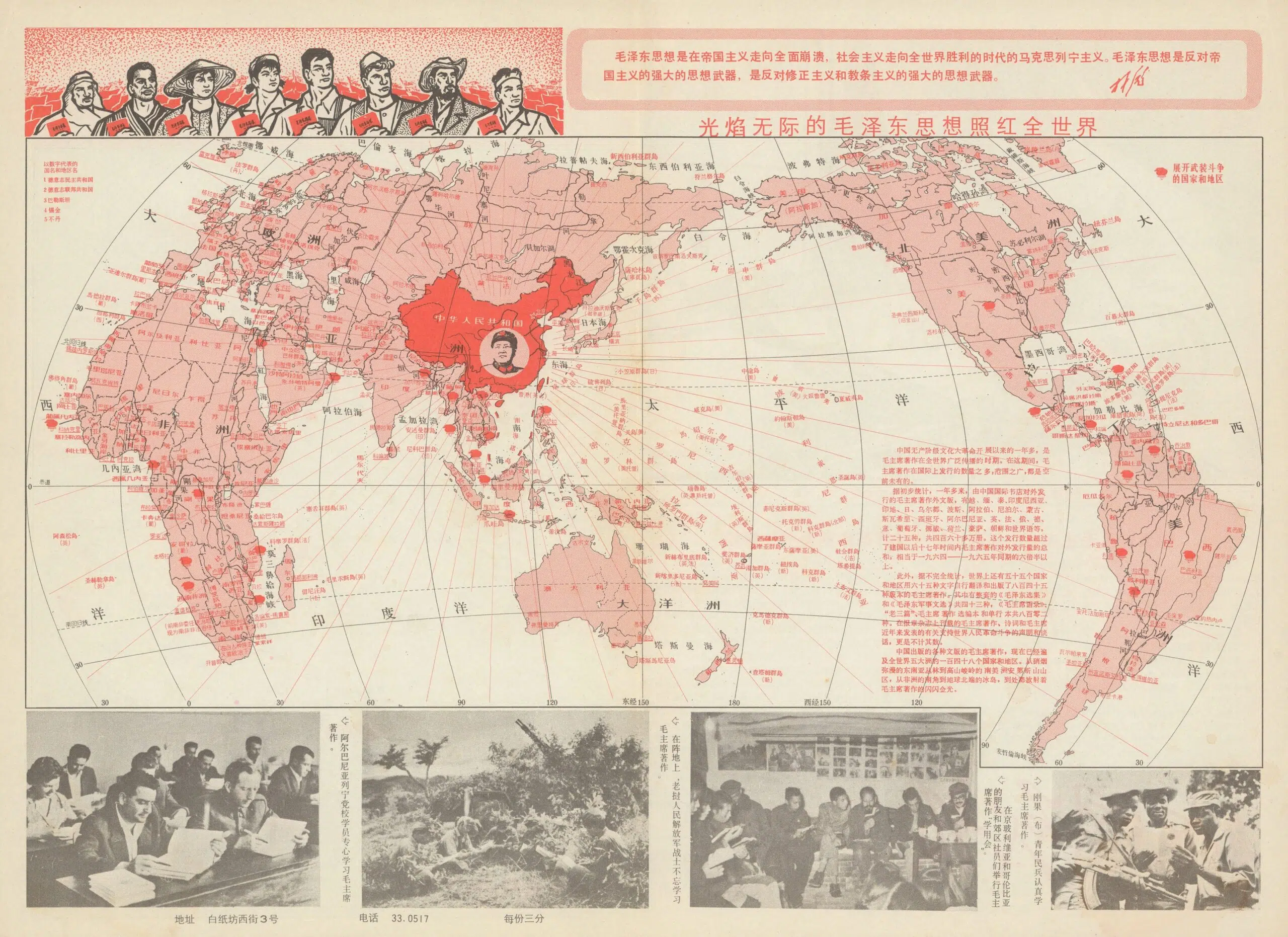
The text deals with the influence of Chinese communism on the international communist movement and global left in general -and vice versa. It covers the period from the foundation of the Communist Party of China in 1921 until today. This interaction is seen in the global perspective with its changing principal contradictions during the past century.
The tension between nationalism and internationalism in the quest for socialism is a recurring theme in this process. In the effort to build socialism, it is today, often forgotten that the strategy of the communist movement from the publication of Manifesto of the Communist Party in 1848 until the 1930s was explicitly the world revolution –or at least anti-capitalist revolutions in most of the world– without this, socialism could not be developed in the different national states.
This strategy was challenged by the Soviets Union’s turn to the development of “Socialism in one country” as a response to the threat of an invasion from Nazi Germany in the 1930s. In the anti-colonial struggle, following the Second World War, nationalism was the driving force in the mobilization, even when communists led the struggle. It was first and foremost a national liberation struggle.
So, besides a few exceptions –Cuba– and for short periods –“The Cultural Revolution” 1965-70– the idea of the world revolution was relegated to a secondary position, and a strategy postponed to a distant future. Socialism has to be built and defended within the national state. This is not surprising –or a mistake– taking into account that capitalism continued to dominate the world-system economically, politically and militarily, however it also limited the possibility to build socialism.
I have never liked the term “Actually Existing Socialism (AES)” to define the Soviet Union in the past, or China today, as they indicate that it is socialism, which exists in parallel –and in competition– with the capitalist mode of production. This is not and has not been the case. What exists is transitional states, with a transitional mode of production, trying to survive and develop a socialist mode of production, within a world-system dominated by the capitalist mode of production. According to Lenin, the Soviet state was “waiting for the tide” of the world revolution as it was essential for the survival of the Russian Revolution. In a political report to the Central Committee on March 7, 1918, Lenin wrote:
Regarded from the world-historical point of view, there would doubtlessly be no hope of the ultimate victory of our revolution if it were to remain alone, if there were no revolutionary movements in other countries. … I repeat, our salvation from all these difficulties is an all-Europe revolution.[1]
As new revolutions in Germany or other European nations did not follow the Russian Revolution, the Soviet Union turned from the strategy of world revolution coordinated by the Communist International (COMINTERN), towards “Socialism in one country” to survive an imperialist invasion. As the national liberation struggle in the Third World in the Long 60s did not lead to an economic liberation from imperialism and the development of socialist states, China made a “controlled” opening up to transnational capitalism to rescue their national project from the offensive of neoliberal globalization.
But that is all history. With the decline of U.S. hegemony, and the rise of China and a multipolar world-system, we see economic and political changes unseen for hundreds of years. For the first time in history a transitional mode of production like in China seems superior to the capitalist mode of production in the imperialist core. This signifies the end of the capitalist mode of production as the dominant form in the world-system and creates an opening for a possible and most needed transfer to a socialist mode of production in the world-system within this century.
This transformation still needs to be made through national revolutions –taking state power– with the aim of building socialism. However, now it is possible for the transitional state to move out of the shadow of the former dominant capital mode of production and get rid of remaining former capitalist features. In a still more globalized world, this also implies the need to develop socialism on the international level, to solve the global inequality inherited from centuries of imperialism, and the ecological problems generated by the capitalist mode of production.
A multipolar world-system is not a wonderland securing a smooth process towards socialism. The future principal contradiction might very well be between different aspirations to build socialism on the national level and the need for a universal global socialism, to save planet earth from future wars and the destruction of its ecological balance and climate. The question of a universal socialist perspective as a strategic aim has re-emerged as a precondition for developing socialism.
To frame the discussion between nationalism and universal socialism, I will begin with the story of the first attempt to carry out the world revolution.
Praeludium: Who will lead the world revolution – West or East?
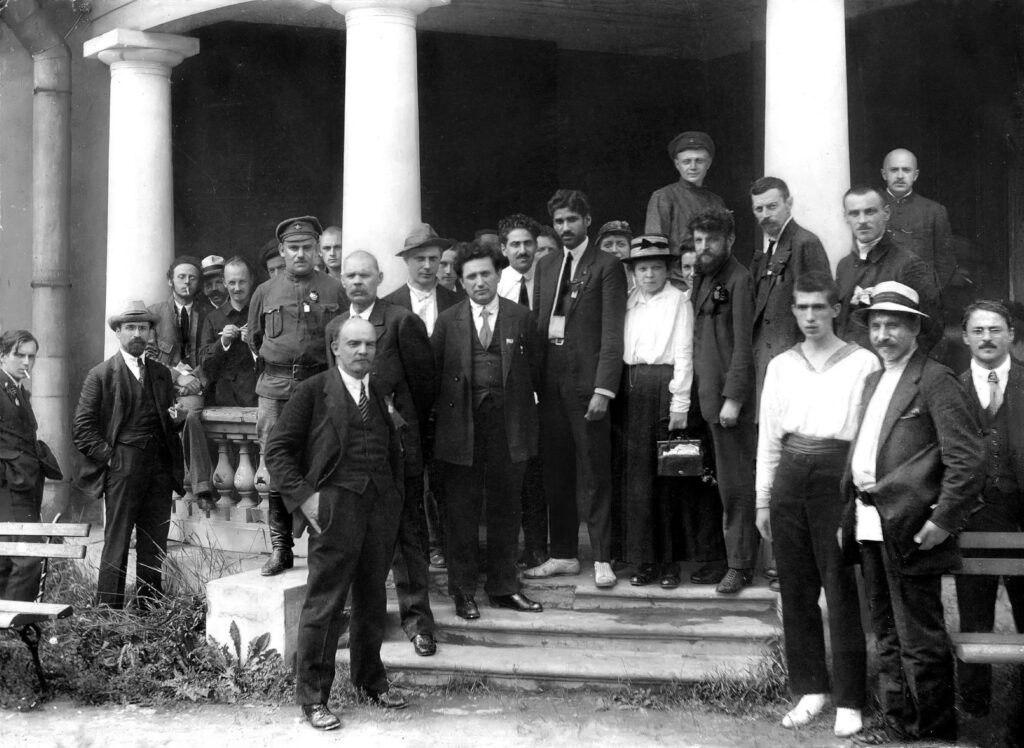
The Soviet Union was the major architect of COMINTERN, the third international attempt to organize the proletariat on a world scale and promote the idea of a world revolution. At the founding congress of the COMINTERN on March 2, 1919, the host was the world’s first state founded by a proletarian revolution. At that time, a wave of revolutionary uprisings was engulfing Central Europe. Lenin assured the delegates that they would one day “see the founding of the World Federative Republic of Soviets.”[2]
COMINTERN was dedicated to promoting and coordinating world revolution. It would provide assistance and disciplined leadership, serving as the Political Bureau (Politburo) of world communism. In contrast to the Second International, the COMINTERN’s position on anti-imperialism was clear cut. A resolution passed at the congress in 1919 read:
At the expense of the plundered colonial people, capital corrupted its wage slaves, created a community of interest between the exploited and the exploiters against the oppressed colonies —the yellow, black and red colonial people— and chained the European and American working class to the imperialist ‘fatherland’.[3]
However, the COMINTERN in 1919 still assumed that the decisive battles for world revolution would be fought in Europe. The “Manifesto of the Communist International to the Proletariat of the Entire World” from 1919 read:
The workers and peasants not only of Annam, Algiers and Bengal, but also of Persia and Armenia, will gain their opportunity of independent existence only in that hour when the workers of Britain and France, having over-thrown Lloyd George and Clemenceau, have taken state power into their own hands. … Colonial slaves of Africa and Asia: the hour of proletarian dictatorship in Europe will also be the hour of your liberation![4]
However, this strategy failed. Britain and France never reached the point of a revolutionary situation, and the revolutionary attempts in Germany, Austria, Hungary, and Finland were crushed. In the end it became the social democrats which benefited from the economic crises after the First World War, forming governments backed by the working-class majority. In Europe, reforms seemed safer than revolution.
In July 1920, the Second COMINTERN Congress met; for the first time including sections from Asia, Africa, and Latin America. The response to the defeats in Europe was to try to increase discipline so as to eliminate reformist and nationalist tendencies. The congress also undertook to create a link between the struggle for socialism in Europe and the anti-colonial struggle.
However, even among Europe’s communists, support for anti-colonial struggles was often half-hearted and it was widely believed that communist movements in the imperial core were more important than those in the periphery. Communists from Asia criticized these attitudes. Pak Din Shoon, the Korean delegate at the 1920 COMINTERN congress, attempted to point attention “to the East, where the fate of the world revolution may very well be decided.”[5] The Indian delegate Manabendra Nath Roy, head of the COMINTERN’s Far Eastern Bureau, declared that the exploitation of the colonies was the limiting factor for a European revolution:
Super-profits gained in the colonies are the mainstay of modern capitalism and as long as these exist, it will be difficult for the European working class to overthrow the capitalist order. … By exploiting the masses in the colonies, European imperialism is in a position to make concession after concession to the labor aristocracy at home.[6]
At the 1920 congress, there was also an intense debate between Nath Roy from India and Lenin concerning communist strategy in the colonies. Due to the relative weakness of communist parties there, Lenin suggested that they should forge alliances with bourgeois democratic movements. Roy, however, opposed any collaboration with the Indian National Congress, which he considered to be a “debating society.” Lenin pointed out that there was no functional communist party in India, and that, under these circumstances, the idea of communists acting alone was doomed to fail.[7] He added that there was “not the slightest doubt that every national movement can only be a bourgeois-democratic movement, since the overwhelming mass of the population in the backward countries consist of peasants who represent bourgeois-capitalist relationships.”[8]
The COMINTERN adopted a series of positions on the “national and colonial question.” Communists in Asia were directed to immerse themselves in the struggle for national independence and to form alliances with other movements for colonial freedom. The revolutions in the colonial world were seen as a two-stage process: first, a national bourgeois revolution against colonial rule, and then a socialist revolution.
In China, at the time a semi-colonial country, the May Fourth Movement sparked such a nationalist uprising in 1919, which contributed to the reorganization of the Nationalist Party (Kuomintang) and also pushed for the founding of the Communist Party of China in 1921. This provided a testing ground for the COMINTERN’s strategy. The Communist Party of China under the COMINTERN’s direction, established an alliance with the Kuomintang, in an attempt to create a bourgeois revolution. The communists allowed the Kuomintang to take military leadership in the struggle against the warlords. However, the COMINTERN strategy led to a catastrophe for the Communist movement as we will see.
In September 1920, the COMINTERN organized a “Congress of the Peoples of the East” in Baku, Azerbaijan. The congress was the first forum where anti-colonial militants met to discuss the future of the peoples of the East. The goal was to establish a common understanding of the fight against imperialist domination and capitalist exploitation, and to form an alliance between the COMINTERN and the anti-colonial liberation movements in Asia, with the ultimate objective being to win them fully to communism.[9]
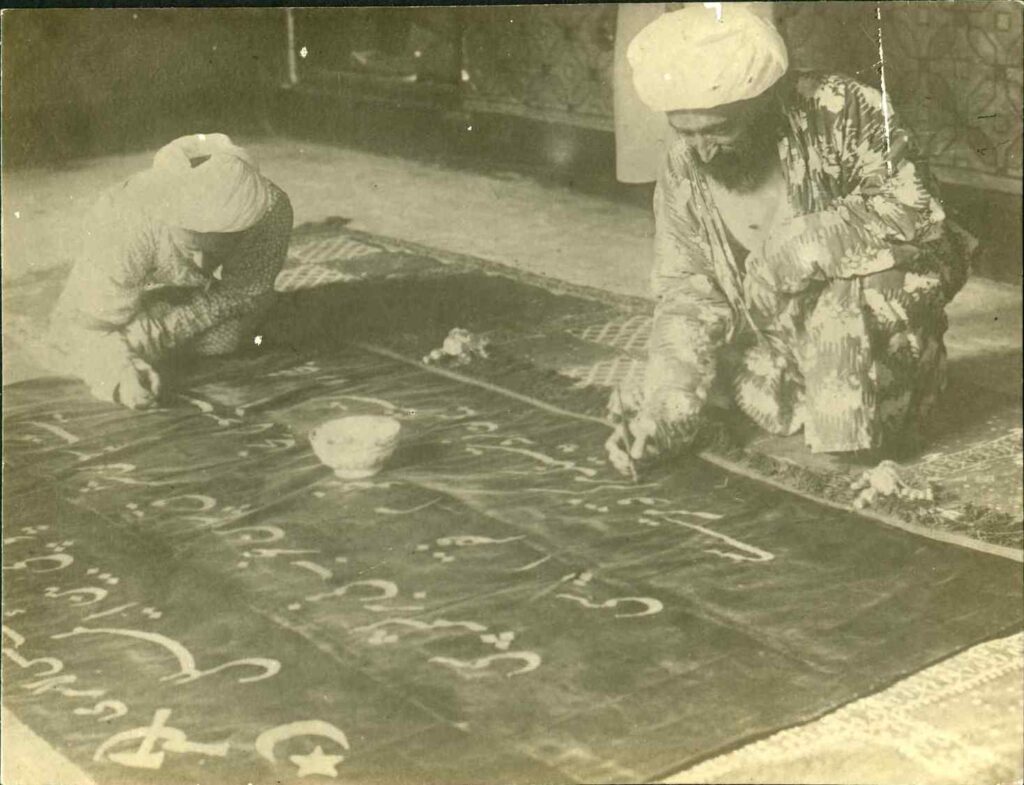
The conference adopted a “Manifesto of the Peoples of the East” with the slogan: “Workers of All Lands and Oppressed Peoples of the Whole World, Unite!” “Oppressed peoples” had now emerged alongside “workers” as fully-fledged revolutionary subjects. This formulation represented an innovation vis-à-vis Marx and Engels —not to abandon the perspective of class struggle and internationalism, but an attempt to grasp the peculiar configuration assumed by each of them in a world-system characterized by increasing international colonial inequality. An executive body was elected to carry out the COMINTERN’s work in the East. At a time when the Soviet Union was close to bankruptcy and facing severe famine, Moscow allotted 750,000 gold Rubles to establish two radio stations with a range of 20,000 kilometers –among the farthest-reaching in the world– to broadcast the message of anti-imperialist politics to the colonized nations of Asia.[10]
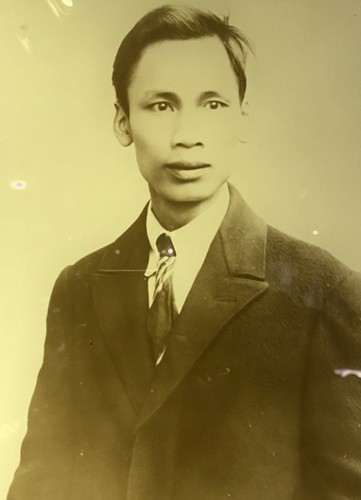
The Fifth Congress of the COMINTERN was held from June 17th to July 8th, 1924. The later leader of the Vietnamese liberation struggle Ho Chi Minh had moved from Paris to Moscow in late 1923, after Lenin’s death, to work for the COMINTERN. He participated in the congress criticizing the communists of Europe for ignoring the colonial question:
You must excuse my frankness, but I cannot help but observe that the speeches by comrades from the mother countries give me the impression that they wish to kill a snake by stepping on its tail. You all know today the poison and life energy of the capitalist snake is concentrated more in the colonies than in the mother countries. … Yet in our discussion of the revolution you neglect to talk about the colonies. … Why do you neglect the colonies, while capitalism uses them to support itself, defend itself, and fight you?[11]
The communist parties of Europe never took Ho’s criticism to heart. In 1925, Ho moved to Canton to deepen contacts with the newly formed Communist Party of China on behalf of the COMINTERN. He also visited Siam (present day Thailand) and other Asian countries to coordinate COMINTERN activities.
The COMINTERN had not given up trying to forge an alliance between the communists of the West and the East. In the mid-1920s, its leadership employed the help of German communist Willi Münzenberg to establish a broad-based front organization for the struggle against imperialism, the League Against Imperialism (LAI).[12] In 1927, the LAI was launched at a congress in Brussels, attended by 174 delegates representing 134 organizations from 34 countries. [13]Albert Einstein, appointed honorary president, proclaimed in the opening speech:
In your congress, the solidly united endeavour of the oppressed to achieve independence takes bodily shape.[14]
For many militants from the colonies, the LAI congress was an opportunity to meet militants from other colonies. They exchanged experiences and discussed future strategies. This explains the historical significance of the event. When Sukarno, as Indonesia’s president, opened the Bandung Conference in 1955, he explicitly mentioned the 1927 LAI-congress as a crucial stepping stone in the development of the anti-imperialist struggle, as BRICS+ today refer to the Bandung conference.
The LAI never lived up to the expectations of the COMINTERN, failing to forge an alliance between the communists of the West and the East. Ho Chi Minh’s doubts concerning the mobilization of European workers for anti-imperialist politics were justified. However, the LAI played a significant role in the adoption of Marxism-Leninism by numerous national liberation movements.
COMINTERN, nevertheless, at the sixth Congress in 1928 continued to try to put the question of anti-imperialism high on the agenda of the communist parties. The COMINTERN secretary Otto Kuusinen presented a document entitled “Theses on the Revolutionary Movement in Colonial and Semi-Colonial Countries.” It addressed the lacklustre approach to anti-imperialist politics by Europe’s communist parties:
It must be admitted that, up until now, not all the parties in the Communist International have fully grasped the decisive importance which the establishment of close, regular and unbroken relations with the national revolutionary movements in the colonies has in affording these movements active and practical help.[15]
For Kuusinen, engaging in anti-colonial politics was “one of the weakest sides of COMINTERN’s activity.” In his opinion, since the COMINTERN’s inception in 1919, communist parties had either ignored anti-colonialism or regarded it as a waste of time.[16] The repeated efforts of the COMINTERN to get the communist parties of Europe to make the anti-colonial question a priority were largely in vain. Many Europeans were convinced that the main purpose of the colonies was to serve their colonizers and this was in their own best interest, since it would bestow civilization upon them. The undeniable suffering that this process entailed was seen as “collateral damage.”
With the rise of fascism in Europe in the 1930s the COMINTERN’s central concern was now the defence of the Soviet Union. At the Seventh –and last– Congress of the COMINTERN in 1935, it became clear that the pursuit of world revolution, and the focus on the countries of the East, were no longer priorities. The sense was, once again, that the future of the Soviet Union would be decided in Western Europe. Stalin had no illusions about the working classes there. In communication with Dimitrov, Stalin wrote:
Without their colonies they [the imperialist powers] could not exist. The workers know this and fear the loss of the colonies. And in this connection, they are inclined to go with their own bourgeoisie. Internally, they are not in agreement with our anti-imperialist policy. They are even afraid of this policy. And for just this reason it is necessary to explain and approach these workers correctly. … We can’t immediately and so easily win millions of workers in Europe.[17]
During the Congress, the anti-colonial struggle was hardly mentioned. After listing various groups that could aid in the struggle against fascism –social democrats, Catholics, anarchists, unorganized workers, peasants, the petty bourgeoisie, and the intelligentsia– Dimitrov now called the peoples’ struggles in the colonies an “important reserve for the world proletariat.”[18]
This completed the transformation of the COMINTERN from an organization to enhance world revolution to one defending the national interests of the Soviet Union. The change of the COMINTERN into an instrument of Soviet foreign policy had laid the roots of the post-war disintegration of the communist movement as a unified international political force. Instead, a variety of different national roads to a transition toward socialism developed.
In an assessment of why the international communist movement turned from a force with worldwide revolutionary ambitions into the servant of the Soviet Union, historian Neil Redfern writes:
It is one of the great ironies of history that the COMINTERN, founded in a rupture with the ‘social-patriots’ of 1914-1918 itself became primarily an organization of ‘social-patriots,’ even if this was perceived as an internationalist defence of the Soviet Union. How can we explain this? For the present writer, the fundamental reason was a materialist reason —the strength of bourgeois ideology, in the imperialist countries, including in the communist movement.[19]
I would like to add that the “strength of bourgeois ideology” was rooted in imperialism, that is, in the fact that the majority of the working class of the imperialist countries benefited from imperialist profits.
A multipolar world-system is not a wonderland securing a smooth process towards socialism. The future principal contradiction might very well be between different aspirations to build socialism on the national level and the need for a universal global socialism, to save planet earth from future wars and the destruction of its ecological balance and climate. The question of a universal socialist perspective as a strategic aim has re-emerged as a precondition for developing socialism.
To sum up: During the 1920s, the COMINTERN genuinely tried to establish a worldwide, class-based, and revolutionary communist movement. It failed. The division of the global working class proved too big an obstacle. In the imperialist countries, “social-patriotism” reigned. Workers identified first and foremost as citizens of their respective nation-states. They were integrated into the nation-state’s political system and the political parties representing them were often included in government —sometimes even leading it. The stratification between the working class in the imperialist center, and the exploited in the periphery, was a gap that the COMINTERN could not cross.
In retrospect, one of the important effects of the Russian Revolution was the establishment of COMINTERN. It was the first –and until now, the only– well-organized and serious attempt backed by a state to enhance a communist world revolution. It did not succeed. But the COMINTERN was a crucial factor in bringing the revolutionary torch from the West to the East and South in the 1920s. In this sense, the Russian Revolution opened up the anti-colonial struggle from the end of the First World War until the mid-1970s. The revolutions of China and Vietnam –along with the processes of decolonization– would have moved more slowly, if not for the COMINTERN.
Since the dissolution of COMINTERN, there has not been an effective International. The communist movement never achieved unity in ideology and action as during the time of Lenin. Instead of the main road towards a coordinated socialist world revolution, the transition was to move on national roads, developing socialism with different national characteristics.
The establishment of the Communist Party of China
If Russia was the semi-periphery of the European capitalist center in 1917, then China was the periphery; or rather, it had been turned into the periphery by nineteenth-century imperialism. The Industrial Revolution in Europe reconfigured the global economic and political order. It was in this context that China was subordinated to Western imperialism. China’s commercial capitalism, already under pressure from internal contradictions, had to give in to foreign competition. China was never properly colonized, but it became a semi-colonial country in which foreign powers established enclaves around Shanghai and other big cities and enjoyed extraterritorial privileges, such as their own administration, courts, and police.
The weakening of the Chinese Empire caused resentment against Western influence. The response was a huge peasant revolt, the Boxer Rebellion (1898-1900). U.S., Great Britain, France, Germany, and Japan sent troops to crush the uprising. The formerly mighty Chinese Empire had been brought to its knees. A nationalist revolutionary movement under the leadership of Sun Yat-sen (1866-1925) emerged to led to the republican Xinhai Revolution of 1911, which ended the Qing dynasty and four thousand years of monarchic rule. But the revolution failed to create national unity. China became more and more fragmented. The following years were characterized by peasant uprisings and feuds between different warlords. The effect of western capitalist penetration into China in the late nineteenth century was described by Mao as:
The collusion of imperialism with the Chinese feudal forces to arrest the development of Chinese capitalism…their purpose is to transform China into their own semi-colony or colony.[20]
The western powers divided up the largest Chinese towns and cities and made them into foreign concessions. They dominated China’s exports and imports. In the absence of the former coherence of imperial state regulation, the extraction of surplus from agricultural production by rural elites intensified and was exacerbated by warlord taxation. The consequence was the underdevelopment of productive forces in China, which led to a hitherto unprecedented impoverishment of the population.
So, it nor surprising that COMINTERN after the defeat of the German Revolution, turned its focus to the East. In East Asia, colonialism created a prime environment for the development of revolutionary socialism, inspired by the Leninist theory of imperialism.
However, because of underdevelopment, Lenin proposed that the small communist parties in the colonies should enter alliances with bourgeois democratic movements to secure national liberation. In China, the “May Fourth Movement” –a nationalist uprising led by students in 1919– became a touchstone of the COMINTERN’s strategy. The May Fourth Movement led to a reorganization of the bourgeois nationalist party, the Kuomintang, still under the leadership of Sun Yat-sen, however more significant, the movement mobilized radical intellectuals, like Li Dazhao (1889-1927) Chen Duxiu (1879-1942) who became founding members of the Communist Party two years later.
Li Dazhao was the first Chinese intellectual to declare support for the Russian Revolution. In an article published July 1918, he described the October Revolution as the beginning of a new wave of global revolutions that surpassed the narrow patriotism of the 1789 French Revolution.[21] The same year Li became the chief librarian and professor of history at Peking University. His library assistant became the young Mao Zedong. Li organized the first Marxist study group at Peking University, which met secretly in his library office, soon known as the “Red Chamber.”[22]
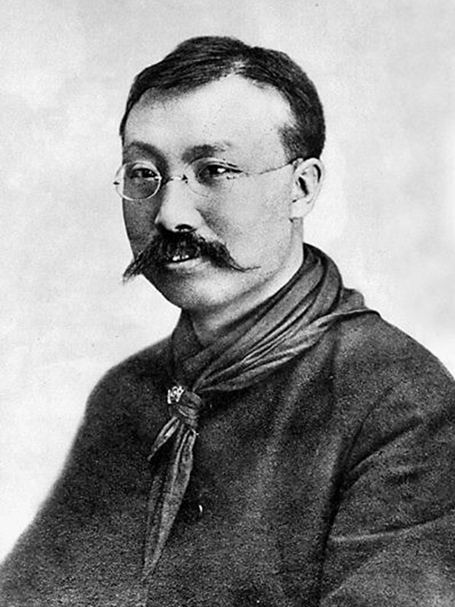
Inside the May Fourth Movement Li was actively spreading communist ideas, publishing more than hundred articles in the following couple of years. Li argued that “China is a rural nation and most of the laboring class is made up of peasants. If they are not liberated, then our whole nation will not be liberated; their sufferings are the sufferings of our whole nation; their ignorance is the ignorance of our whole nation; the advantages and defects of their lives are the advantages and defects of all of our politics.”[23] Based on the revolutionary spirit of the class expressed in the Boxer Rebellion of 1900 and the Xinhai Revolution of 1911, Li saw the peasants as the main force in a future communist-led revolution, This represented an innovation in Marxist thinking, which traditionally relayed on the industrial working class to lead the struggle.[24] On 1 May 1919, he published the article, “My Marxist Views,” which expressed his voluntaristic perspective on revolution. He emphasized class struggle as the conscious political action, in which the “will” and “revolutionary spirit” of the masses –the subjective forces– played a significant role in the material transformation of society.[25]
In January 1920, Li Dazhao put forward the concept of a “proletarian nation.” According to Li, there was a difference in position between the proletariat in the colonies and in the imperialist center. In Europe, the proletariat was only oppressed by the national capitalist class, but in China, the imperialist powers oppressed the entirety of the Chinese people. China as a whole was a proletarian nation. Li’s conception of the Chinese nation being proletarian meant that he included the peasants as a revolutionary force. In a letter dated March 20, 1921, Li wrote:
… although China itself has not yet undergone a process of capitalist economic development such as occurred in Europe, America, and Japan, the common people [of China] still indirectly suffer from capitalist economic oppression in a way that is even more bitter than the direct capitalist oppression suffered by the working classes of the various [capitalist] nations. … Therefore, if we want to develop industry in China, we must organize a government made up purely of producers in order to eliminate the exploiting classes within the country, to resist world capitalism, and to follow [the path of ] industrialization organized upon a socialist basis.[26]
According to Li, although it lacked developed industrial capitalism and a well-defined proletariat as preconditions for building socialism, China was ready for a socialist revolution because it was a nation suffering under the yoke of imperialism.
As we will see, these questions became recurring themes in the “Sinification of Marxism” and provided the basis for the subsequent development of “Socialism with Chinese Characteristics,” as they were rooted in China’s economic and political realities, as well as its position in the periphery of the capitalist world-system.
In February 1920, Li teamed up with Chen Duxiu, Dean of Arts and Letters at Peking University, which also was radicalized by the May Fourth Movement. They met the COMINTERN’s Grigori Voitinsky in Beijing to plan the foundations of a communist party. In May 1920, Chen Duxiu established a communist cell in Shanghai, and Li founded a cell in Beijing.[27] This arrangement established the informal leadership structure known as “Chen in the South, Li in the North.”
According to Party documents, the Communist Party of China was founded on July 23-24, 1921, at secret meetings, the first of which, in Shanghai’s French Concession, was disturbed by security forces, leading to the delegates leaving for nearby Zhejiang province, with the proceedings being completed on a houseboat on a lake to avoid further disruption. These meetings were attended by at most 13 people, including Mao Zedong. They represented just 53 members. In addition, two representatives of the COMINTERN were present as advisors. Li was unable to attend and was represented by one of his students, and Chen Duxiu was elected the first General Secretary.
In 1922, COMINTERN instructed the Chinese communist to form a “United Front” with Sun Yat-sen’s Kuomintang (KMT). The policy was based on the premise that the Chinese Revolution was in its “bourgeois-democratic” phase and required a cross-class national alliance against imperialism and warlordism. Heeding the advice of the COMINTERN, the (at the time) rather small Communist Party thus allowed the Kuomintang to take the lead in the national liberation struggle. At this stage, Li Dazhao advocated for a broad national united front and played a central role in formalizing the alliance. Li interpreted the alliance as representing China as a “proletarian nation.” After meeting with the COMINTERN agent Maring and Li in Shanghai in August 1922, Sun Yat-sen agreed to allow communist members to join the KMT, and in the autumn of 1922, Li became the first member of the communist party to join the KMT as an individual.[28] In January 1923, the Soviet Union signed a pact with Sun Yat-sen and the KMT to wage a campaign against the warlords in China. The Communists and KMT established a joint military academy -with Chiang Kai-shek in charge and the communist Zhou Enlai as second in command. Another key figure in the new military cooperation was Mao; in fact, he was so successful that he was elected to the Central Executive Committee of KMT in January 1924.[29]
Another advice from COMINTERN to the Communist Party of China was to base themselves within the urban working class. In January 1922 the Communist Party organized a seamen strike in Hong Kong. Over the next twelve months, more than 300.000 workers participated in about hundred strikes, However, the Peking-Hankou Railway Workers’ Great Strike became a turning point for that strategy. The strike was crushed by soldiers and police ended with the death of 52 workers, hundreds injured and thousands being expelled from their job. The event destroyed the communist labor base in northern China.[30]
This confirmed Li in his analysis, that the potential of the urban proletariat was not strong enough to stand up against the repression. The revolution has to be based on the peasants, and a Red Army organized in the countryside.
In March 1925, Sun Yat-sen passed away and Chiang Kai-shek, representing the right wing and an anti-communist trend, seized power in the KMT. This caused the United Front between the Communists and KMT in northern China to collapse by the end of 1925.[31] In an article about the “Red Spear Societies,” which were traditional secret peasant organizations leading the revolt in the North, Li expressed the need for the Communist Party to change its strategy, and also expressed his full support for an armed peasant revolt.[32] He argued that the peasantry, by its military organization and class consciousness, could defeat the landlords, warlords and imperialists. He called on young revolutionaries to go to the villages and join these movements.[33]
Mao reaches the same conclusions as Li, in Report on an Investigation of the Peasant Movement in Hunan in March 1927. It is a classic class analysis in which Mao identifies the poor peasants as the primary revolutionary subjects and urges the Communist Party to take the lead in their struggle.
In a very short time, in China’s central, southern and northern provinces, several hundred million peasants will rise like a mighty storm, like a hurricane, a force so swift and violent that no power, however great, will be able to hold it back. They will smash all the trammels that bind them and rush forward along the road to liberation. They will sweep all the imperialists, warlords, corrupt officials, local tyrants and evil gentry into their graves. Every revolutionary party and every revolutionary comrade will be put to the test, to be accepted or rejected as they decide. There are three alternatives. To march at their head and lead them? To trail behind them, gesticulating and criticizing? Or to stand in their way and oppose them? Every Chinese is free to choose, but events will force you to make the choice quickly.[34],[35]
The shift in strategy became sealed by the events in Shanghai in March 1927. In the spring of 1925, the Communists led a successful strike in Shanghai, and within a few months, their membership reached 30,000. As the KMT army approached Shanghai in March 1927, the workers, under communist Zhou Enlai’s leadership, seized the city from within. Since taking over the KMT two years ago, Chiang Kai-shek had been undermining the Communists’ influence, and now, he sought to eliminate them. He used criminal gangs in the city to attack workers of Shanghai while the KMT army laid siege. On April 12, 1927, a massacre ensued. Thousands of Communists and unionists were killed. Zhou, with a bounty of 80,000 dollars on his head, managed to escape. The “Shanghai Massacre” initiated the nationwide destruction of the urban communist movement. Uprisings in Guangzhou, Changsha, and Nanchang were crushed. In the space of twenty days, more than 10,000 communists across China’s southern provinces were arrested and executed. By 1928, it is estimated that as many as 300,000 people died in the KMT’s anti-communist extermination.[36]
Mao believed that the struggle would be prolonged, taking years to gradually expand from a secure base and encircle the cities from the rural areas. These components of strategy and tactics were appropriate for both a total strategy and more limited operations.
Also, in Beijing the political situation deteriorated. In a demonstration in which Li Dazhao made an anti-imperialist speech was attacked by armed military police, 47 protesters were killed and more than 200 were wounded including Li Dazhao. A warrant was issued for Li’s arrest. He took refuge in the Soviet embassy, from where he continued to lead communist activities in Beijing.[37] However, in April 1927, the Manchurian warlord who controlled Beijing, ordered a raid on the Soviet embassy with the approval of the Western foreign diplomatic corps. Li Dazhao, his family and about sixty other communists and left-wing KMT members were arrested.[38] After a brief trial by a military court, Li and nineteen others were executed by hanging on 28 April, just two weeks after the Shanghai massacre.[39] This became a turning point in the Communist Party of China’s strategy. It ended the First United Front with KMT and changed the Communists’ focus from the cities to the rural areas.
The Praxis of Chinese Marxism
Mao’s merit was that he was able to transform Li Dazhao thoughts on the struggle in China into a concrete revolutionary strategy and praxis. In that process, the former assistant librarian turned into a commander-in-chief, not only by building the Red Army as a mighty force but also by developing a military strategy and tactics over the next few decades for a protracted agrarian people’s war, which inspired revolutionary struggles worldwide.[40] Mao’s military strategy developed in two interlinked contexts: The revolutionary war against KMT (1927-37 and 1945-49) and the national liberation war against Japan (1937-45). In the national liberation struggle, the communist Red Army proved to be the staunchest defender of the Chinese nation, which laid the foundations for the victory over KMT in 1949. The theme of national liberation also became central to the manner in which Mao’s guerrilla strategy was applied in the struggle against colonialism and neocolonialism in Asia, Africa and Latin America throughout the rest of the 20th century.[41]
As the cities became unsafe for the Communists, members were transferred to the countryside. Mao retreated to the isolated hills on the border of Jiangxi province, which became a communist base. It was here that Mao developed the skills of guerrilla warfare, learning much from the secret peasant societies and local bandits, i.e., the lumpenproletariat.
The fall of the Qing Dynasty and the impact of imperialism created a society in dissolution haunted by rivaling warlords destroying the basis of existence for vast masses of people through war and expulsion. This process expanded the so-called lumpenproletariat. This class of people had been forced out of their traditional socioeconomic roles and were often criminalized. They had no steady relationship with the labor market and lived of casual work and/or charity from friends, family, and clan relations. This group included homeless people, beggars, petty criminals, gang members involved in organized crime, and sex workers.
Traditional Marxism has a negative attitude towards the lumpenproletariat.[42] They lack a clear class position and are likely to be mobilized by reactionary forces, as was the case in the Shanghai Massacre in 1927. However, a look at the history of uprisings reveals that the lumpenproletariat has also played a progressive role in the revolutionary process. This has been evident from the Paris Commune to the uprising in Gaza. One of the major examples of the mobilization of the lumpenproletariat is also the Chinese Revolution. Mao wrote in his class analysis of Chinese society in 1926:
… there is the fairly large lumpenproletariat, made up of peasants who have lost their land and handicraftsmen who cannot get work. They lead the most precarious existence of all…One of China’s problems is how to handle these people. Brave fighters but apt to be destructive, they can become a revolutionary force if given proper guidance.[43]
Mao knew the lumpenproletariat very well. In 1929, he stated that “the lumpenproletariat constitutes the majority of the Red Army,” which was scornfully called the “vagabond army” by the KMT. The lumpen brought to the Red Army practical combat experience and tactical knowledge from gang activity, as well as an extreme toughness. Here they were met with acceptance instead of prejudice. When Edgar Snow asked the soldiers of the Red Army about the reasons for their adherence to the armed struggle undertaken by the Communist Party, they responded:
… the Red Army has taught me to read and write. … Here I have learned to operate a radio, and how to aim a rifle straight. The Red Army helps the poor. … Here everybody is the same. It’s not like the White districts, where poor people are slaves of the landlords and the Kuomintang.[44]
In May 1928, Mao welcomed Zhu De to the Red Army, an ex-bandit who had joined the Party and was to become a famous general in the Red Army. With the practical experience from the peasants and lumpenproletariat organizations, and inspiration from the ancient Chinese philosopher and general Sun Tzu (500 BC), Mao developed the strategy of the Red Army over the next decade.
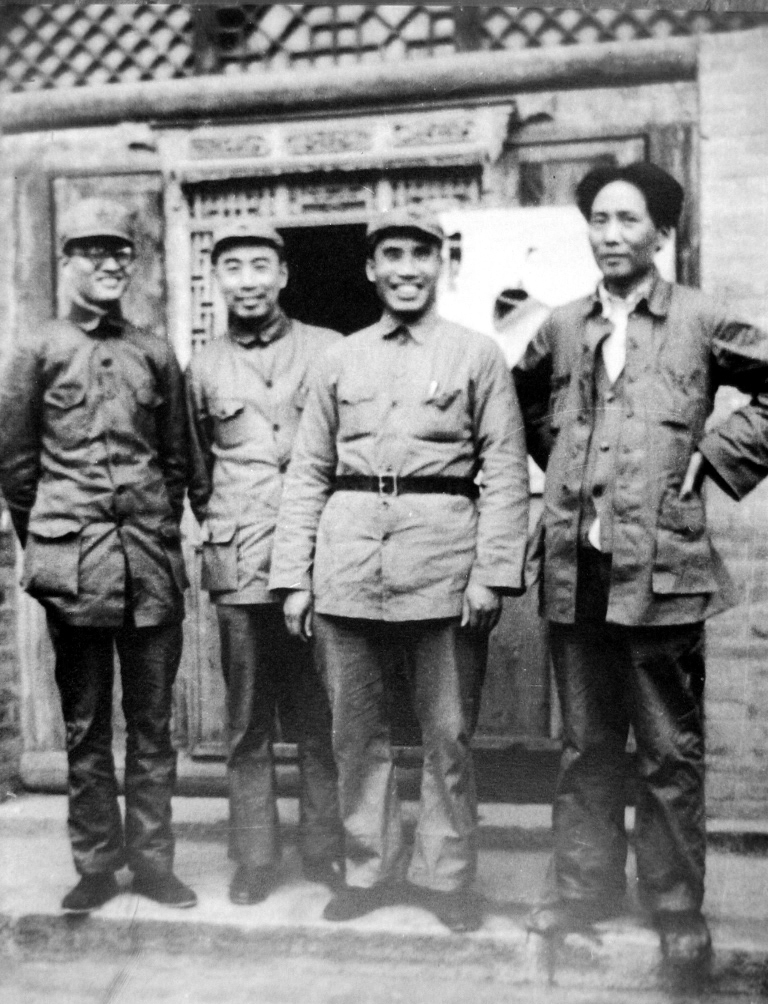
One of his first conclusions he made was the need for an armed, disciplined, politically conscious, regular army for the conquest of power. Strikes, demonstrations, barricades in the streets, the self-armed masses, were not enough to do the job, at least not in the specific case of China. An organized army unit was necessary. In October 1928, Mao wrote:
… the existence of a regular Red Army of adequate strength is a necessary condition for the existence of Red political power. … Therefore, even when the masses of workers and peasants are active, it is definitely impossible to create an independent regime, let alone an independent regime which is durable and grows daily, unless we have regular forces of adequate strength.[45]
Mao saw it as his responsibility to provide the party with an effective “gun,” i.e., the Red Army. Ten years later, in 1938, he concluded:
Every Communist must grasp the truth, ‘Political power grows out of the barrel of a gun.’ Our principle is that the Party commands the gun, and the gun must never be allowed to command the Party. … According to the Marxist theory of the state, the army is the chief component of state power. Whoever wants to seize and retain state power must have a strong army. … Experience in the class struggle in the era of imperialism teaches us that it is only by the power of the gun that the working class and the labouring masses can defeat the armed bourgeoisie and landlords; in this sense we may say that only with guns can the whole world be transformed.[46]
The Red Army fighters received considerable political education. A highly motivated soldier would fight with unflinching courage and determination. The human factor, not superior weapon technology, was decisive in the war.
One point that Mao stressed was the unity within the army and between the army and the people, a doctrine rooted in China’s ancient martial tradition. Hence, Mao issued “Eight Points for Attention” to the Red Army when they were in contact with the people:
-
- Be polite when speaking
- Be honest when buying and selling
- Return all borrowed articles
- Pay compensation for everything damaged
- Do not hit or swear at others
- Do not damage crops
- Do not harass women
- Do not mistreat prisoners[47]
Mao’s military writings were not intended for generals or academics; his audience was made up of young peasant soldiers and political cadres. The language was direct, simple, objective and to the point:
The enemy advances, we retreat; the enemy camps, we harass; the enemy tires, we attack; the enemy retreats, we pursue.[48]
“Avoid strength and strike at weakness” sums up the essence of the ancient strategist Sun Tzu’s teachings.[49] Operationally, this was expressed in the refusal to engage in combat unless victory was certain. This tactic was based primarily on accurate intelligence, of both the enemy and the terrain, which was often provided by local supporters. The Red Army was like a fish in the water. Second, they relied on their ability to concentrate a superior force at the time of battle and eliminate enemy units one by one. This required careful, secret preparations and a sudden, rapid attack. They planned everything down to the last detail, leaving nothing to chance.
Since the guerrilla force is weaker in material terms, it is essential to take the initiative. As Sun Tzu wrote, “Move when it is advantageous and create changes in the situation by dispersal and concentration of forces.”[50]
Mao believed that the struggle would be prolonged, taking years to gradually expand from a secure base and encircle the cities from the rural areas. These components of strategy and tactics were appropriate for both a total strategy and more limited operations.
The result of this strategy was astonishing. By 1930, the Red Army had established the Chinese Soviet Republic in the provinces of Jiangxi and Fujian, comprising 3 million people. In the areas controlled by the Communists they began to distribute land seized from rich landowners to the peasants and organized the economy with different forms of property ownership in order to get the wheels of the economy running. Edgar Snow described the economy in the “liberated” areas:
Soviet economy in the Northwest was a curious mixture of private capitalism, state capitalism, and primitive socialism. Private enterprise and industry were permitted and encouraged, and private transactions dealing in the land and its products were allowed with restrictions. At the same time the state owned and exploited enterprises such as oil wells, salt wells, and coal mines, and it traded in cattle, hides, salt, wool, cotton, paper, and other raw materials. But it did not establish a monopoly in these articles and in all of them private enterprises could, and to some extent did, compete. A third kind of economy was created by the establishment of cooperatives, in which the government and the masses participated as partners, competing not only with private capitalism but also with state capitalism![51]
However, the establishment of the Chinese Soviet Republic meant that the Communist Party devoted much time and energy to governing the Republic with the help of experts sent by the Soviet Union. The military strategy then became defending the Republic against the KMT’s encirclement. Mao’s flexible guerrilla strategy was not suitable for defending and consolidating the Soviet Republic’s territory. How could the Chinese Soviet Republic defend itself and expand as a small state within a larger state controlled by enemy armies?
These different opinions on military strategy, as well as the ongoing debate about whether the industrial proletariat or the peasant class should lead the revolution, caused Mao to clash with key Party members, including Chen Duxiu. Chen’s priority was a revolution like that of Russia in 1917, led by the working class. Chen saw the defeat of this strategy in 1927-28 as demonstrating the futility of working toward a socialist revolution in China. Instead, he opted for a bourgeois-democratic revolution led by the capitalist class. Chen denied that a radical land policy and vigorous organization of the rural areas under the Communist Party were the way forward.
One of his first conclusions he made was the need for an armed, disciplined, politically conscious, regular army for the conquest of power. Strikes, demonstrations, barricades in the streets, the self-armed masses, were not enough to do the job, at least not in the specific case of China. An organized army unit was necessary.
This division within the Party came to a head after Chen and many of the elder Party members refused to publish one of Mao’s essays, Analysis of the Classes in Chinese Society, in the central executive organ.[52]
The difference in strategy concerning alliances led Mao to campaign against his opponents, accusing them of being de facto agents of the KMT. In December 1931 this made the Party replace Mao with Zhou Enlai as Secretary of the First Front Army and political commissar of the Red Army. The conflict was discussed at the Party Conference in Ningdu in 1932.[53] Liu Bocheng, Lin Biao, Zhu De, and Peng Dehuai all criticized Mao’s strategy. Mao received support from Zhou Enlai, but it was not enough. Mao was demoted to figurehead status. The COMINTERN placed two political commissars, Bo Gu and Otto Braun, alias Li De, a German communist, in Jiangxi. As emissaries of the COMINTERN, they had the authority to dictate policy. Because they disagreed with Mao’s guerrilla strategy, they exclude him from the Central Committee. In the autumn of 1934, Braun assumed command of the Red Army, together with Bo and Zhou Enlai. Braun and Bo enforced a conventional military strategy. Braun advocated a direct attack on the larger, better-equipped KMT. This strategy played into the hands of Chiang Kai-shek, and the communist army suffered great casualties. Slowly, the KMT army encircled Jiangxi. Within a year, the Communists lost sixty thousand soldiers and half of their territory. They had no alternative but to retreat to a more secure remote base area.
The importance of a secure rear base is an essential part of Mao’s military strategy. Mao explained it to the soldiers in a picturesque term as one of the soldiers recalls:
A revolution’s need for a base area was just like an individual’s need for buttocks. If an individual didn’t have buttocks, he wouldn’t be able to sit down. He would have to run around or stand all the time and would certainly not be able to hold out long. … It was only when a revolution had a base area that there was a place to rest and recuperate, to regain strength, to recruit new forces, and thus to continue the struggle on an ever wider bases until final victory.[54]
Thus, the need to break free from the encircled Jiangxi and take the Long March north to reach a secure base area for the continued long-term people’s war for revolution emerged.
The Long March
On October 16th, 1934, the remaining Red Army soldiers and party cadres, led by Bo Gu and Otto Braun, began the “Long March.” After escaping encirclement, it was obvious that the KMT Army intended to pursue what remained of the Red Army. There were disputes between Bo and Braun versus Mao on both route and military tactics.[55] In these confrontations, Zhou supported Mao’s proposals and encouraged other leaders to overrule the objections of Bo and Braun. It was decided that all military plans had to be submitted to the Politburo for approval, depriving Braun of the right to direct military affairs. On January 15, 1935, the Red Army captured Zunyi, the second-largest city in Guizhou. Zhou used the opportunity to call an enlarged Politburo meeting. In the meeting, Mao again opposed Braun and Bo’s military tactics. Their direct attacks were costing too many lives of the Red Army. Instead, Mao suggested that their smaller, more poorly equipped forces should retreat when under pressure and make surprise pinprick attacks, using guerrilla tactics. Braun and Bo were removed as commanders and Mao became Zhou’s assistant leader of the Long March.[56] After this conference, the COMINTERN was pushed aside as an influential force in the Communist Party.
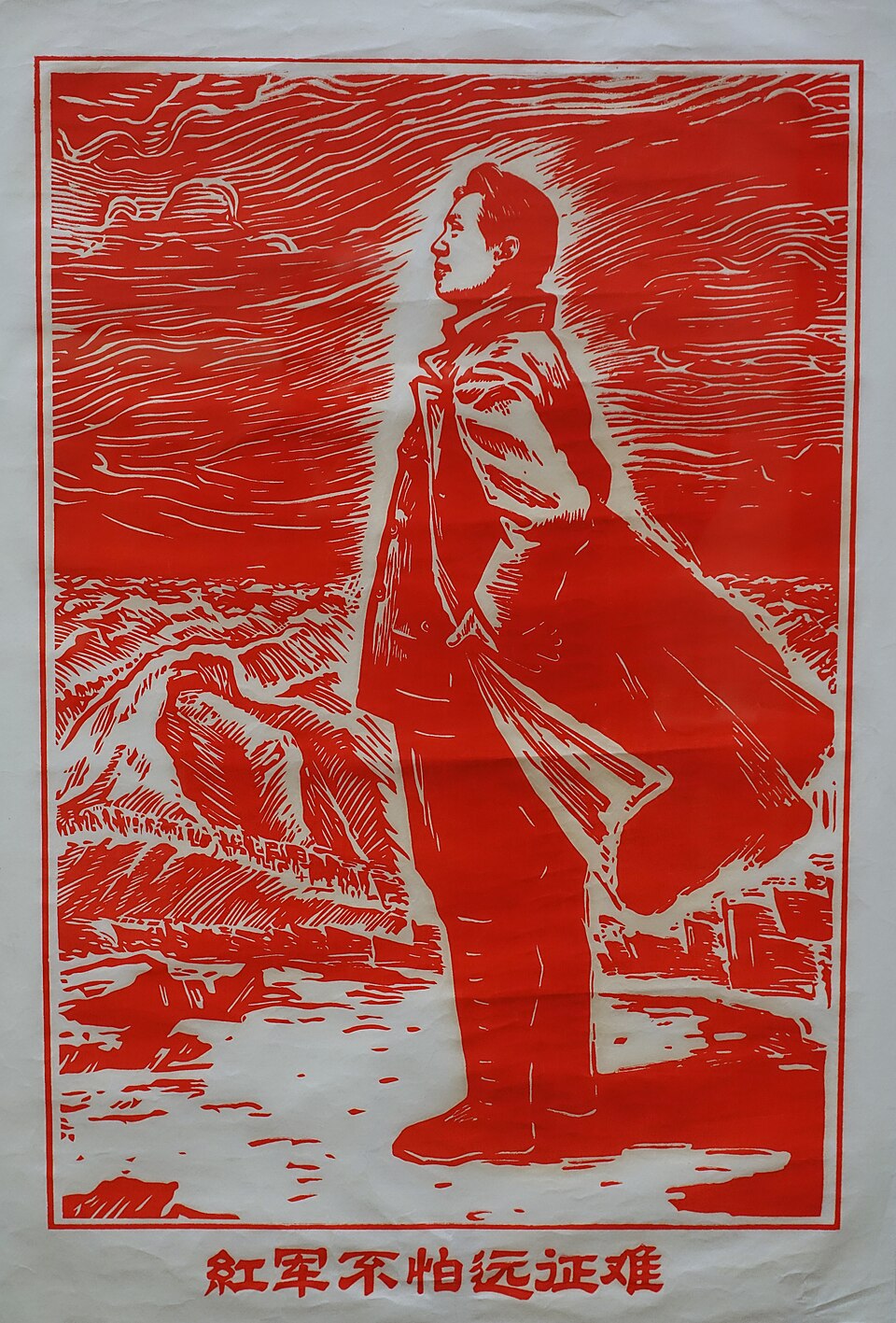
During the Long March, the Communist Army confiscated property and weapons from warlords and landlords and recruited new members from the peasants and lumpenproletariat. Nonetheless, only 8,000 troops out of the 86,000 who tried to escape from the KMT Army ultimately survived. The Long March provided the Communists with a secure base in Yan’an that they needed to recuperate and rebuild. In November 1935, Mao became the Chairman of the Military Commission, with Zhou and Deng Xiaoping as Vice-Chairmen.
The Long March was vital to the Chinese Communists in translating their Marxism from socialism with Soviet Characteristics to Chinese Characteristics. It not only created a physical distance between the Communists and the KMT, but also a political distance between the COMINTERN’s Eurocentric interpretation of Marxism and the Chinese interpretation of Marxism. Mao’s evaluation of the COMINTERN was mixed:
When Lenin was alive, the Third International was well led. After Lenin’s death, the leaders of the Third International were dogmatic leaders (for instance, leaders [like] Stalin, Bukharin were not that good. … Of course, the Third International had [its] merits as well, for instance, helping various countries to establish a [communist] party. Later on, [however] the dogmatists paid no attention to the special features of various countries [and] blindly transplanted everything from Russia. China [for one] suffered great losses.[57]
What Mao did during the Long March and in Yan’an was to adapt theoretical Marxism and the experience of the Soviet Union to the specific Chinese situation. The term “Sinification” of Marxism was coined by Mao in 1938 for the re-issue of the Selected Works of Mao Zedong, where he used the term instead of his original phrase of “concretion of Marxism in China.” The term “Sinification” seemed more apt since the basic principles of Marxism belong to the world, not only to China. Each revolution has to apply Marxism to its specific time and place. “Copy and paste” does not work. The concept of “Socialism with Chinese characteristics” is not a post-Mao term.[58] In his report to the Central Committee of the Party in 1938 Mao said:
A Communist is a Marxist internationalist, but Marxism must take on a national form before it can be put into practice. There is no such thing as abstract Marxism, but only concrete Marxism. What we call concrete Marxism is Marxism that has taken on a national form, that is, Marxism applied to the concrete struggle in the concrete conditions prevailing in China, and not Marxism abstractly used. If a Chinese Communist … talks of Marxism apart from Chinese peculiarities, this Marxism is merely an empty abstraction. Consequently, the Sinification of Marxism –that is to say, making certain that in all its manifestations it is imbued with Chinese characteristics, using it according to Chinese peculiarities– becomes a problem that must be understood and solved by the whole Party without delay.[59]
The principal contradiction
Besides Mao’s class analysis of China, with the emphasis on the peasants as the revolutionizing agent, and his development of a military strategy for the struggle, a third major contribution to Marxism is his writings on dialectics.
In times of crisis, turmoil and a complex situation it is helpful to take a step back and consult dialectical materialism. Not as an escape from reality, but to get a basic grip on how to analyze the situation. This was the case at the base camp in Yan’an, when Mao lectured the cadres in dialectical philosophy. The purpose was to give them the capability –a tool– to develop strategies for the decisive coming struggles. Mao summed up his lectures in the short, simply formulated and yet profound text: On Contradiction.[60] In this text Mao develops the concept of the “principal contradiction,” which is a significant contribution to dialectics.
Mao defines the principal contradiction in this way:
If in any process there are a number of contradictions, one of them must be the principal contradiction playing the leading and decisive role, while the rest occupy a secondary and subordinate position. Therefore, in studying any complex process in which there are two or more contradictions, we must devote every effort to finding its principal contradiction. Once this principal contradiction is grasped, all problems can be readily solved.[61]
The principal contradiction has a decisive effect on other contradictions; however, the interaction is not one-sided. The feedback from related contradictions affects the struggle between the aspects of the principal contradiction, changes its direction, and can even change the principal contradiction itself.
The principal contradiction is not general and abstract. It is the concrete economic development, the specific political and military actions, by specific political movements and organizations, being driven by class struggle and interstate competition. The principal contradiction is not just a philosophical concept; it is a very practical methodical tool for developing strategy and praxis. Hence, the need to define its aspects are very specific and concrete.
Why is it important to be able to identify the principal contradiction in the process of developing strategy? As Mao states above: “Once this principal contradiction is grasped, all problems can be readily solved.” The expression “readily solved” should be taken with a grain of salt, not least when we talk about social problems and revolutions in a country the size of China —or the world-system in totality. What Mao means when he says “readily,” is that you have a reliable guide for further analysis once you have identified the principal contradiction. In other words, the decisive problem of defining useful strategies, policies, and military efforts are solved.
Note that Mao speaks of “finding” the principal contradiction in the quote above. This cannot be based on speculation. Theoretical knowledge about dialectical materialism cannot replace concrete studies. “Contradiction” is an abstract concept, but real-life contradictions on the ground are very concrete. Moreover, we cannot simply copy the analysis of one country and time and apply its results to another situation. What is needed is the analysis of the specific situation. To analyze and get one’s bearings in such a complex situation, it is necessary to examine not only the internal configuration of each contradiction but also how they interact and are structured in a concrete totality.
The meaning of seeing things as an interconnected whole lies in the ensuing capacity to act in line with reality thus understood. The ultimate purpose of identifying the principal contradiction is to intervene in it. We cannot create contradictions, but we can influence the aspects of existing ones so that the contradictions move in a way that serves our interests. Identifying the principal contradiction tells us where to start. Dialectics allows us to analyze the world as an interconnected, contradictory, and changing totality.
The principal contradiction on the world level
As the economic and political development of the world-system, since the breakthrough of capitalism, has increasingly become one process, the primary contradiction of this process has also become increasingly global, driving the system forward. It was imperialism which united and polarized the world-system in a center-periphery structure, first by colonialism, then by neocolonial imperialism and neoliberal globalization, and now to the renewed geopolitical struggles in the world-system. These historical phases of imperialism are characterized by different principal contradictions, which are specific concrete representations of how the fundamental contradictions in capitalism are managed at certain points in history.
From around 1900 until the end of the Second World War the principal contradiction in the world-system was the inter-imperialist rivalry of who was going to succeed Britain as the hegemonic power in the world —with the U.S. and Germany as the main competitors. Changes in the economic strength between the imperialist counties, in the framework of competing colonial empires, had to be settled by wars over territory.
This principal contradiction had a decisive effect throughout the world. It was the First World War, which made the space for the Bolsheviks to carry out the Russian Revolution. In 1923, Lenin expressed the hope that the contradiction between Western and Eastern imperialism (U.S. vs. Japan) would provide a bit of breathing room for the Soviet Union.
The principal contradiction is not general and abstract. It is the concrete economic development, the specific political and military actions, by specific political movements and organizations, being driven by class struggle and interstate competition. The principal contradiction is not just a philosophical concept; it is a very practical methodical tool for developing strategy and praxis. Hence, the need to define its aspects are very specific and concrete.
By the end of the 1930s, inter-imperialist rivalry again reached a climax. Germany sought, once more, to become a major global political power based on the strength of its industrial production. The rivalry escalated when Germany invaded Poland, and Britain declared war on Germany. Things escalated further when Germany attacked the Soviet Union, and Japan the U.S. in 1941.
Germany intended to break the old colonial powers’ grip on Africa and Asia, and turn Eastern Europe, the Balkans and Russia into semi-colonies, exploiting their raw material and labor. Japan intended to turn China into a colony and rule the Pacific Ocean.
During the Second World War, the principal contradiction was specific between the “Axis Powers” (led by Germany and Japan) as one aspect and the “Allies” (led by the USA and Britain) as the other aspect. Like the First World War, the Second World War was a fight over control of the world’s territories.
The contradiction between the Allied versus the Axis forces affected all other contradictions worldwide. It led the Soviet Union to first enter a non-aggression pact with Nazi Germany to postpone an invasion, and then to enter the alliance with its former enemies, the U.S. and Britain against Germany, to secure the existence of their transitional state. In China, the Communist Party re-entered an alliance with the KMT against the Japanese invasion in spite of the fact that they had fought a life and death struggle against the KMT for a decade. The Japanese invasion enabled the Communists to appeal to the nationalism of the peasants, as well as to their hunger for land.
Mao’s use of the “principal contradiction” to make this difficult decision, is a prime example of how to use this tool to develop strategy in a complex situation. By creating a United Front with the KMT against Japan, Mao did not only secure the liberation of China from the occupation; the United Front also tied up huge Japanese military forces in China and so prevented Japan from attacking the Soviet Union from behind in support of Nazi Germany’s invasion.
By taking this bold decision, the Chinese communists decisively supported the allied aspect of the principal contradiction. It is doubtful that the Soviet Union could have defeated Germany in a two-front war, and the outcome of the Second World War would have been very different. Had the Axis Powers won the war, Germany and Japan would have probably divided the Soviet Union between them. Now instead in China:
The rear battlefield became Japan’s bleeding wound. … The occupiers controlled the cities and railways; the resistance controlled everything else. … The occupied zones were graveyards, not colonies. … Every blown railway, every ambushed convoy demonstrated a simple truth: superior weapons meant nothing when every village was hostile, every peasant an intelligence network, every night an opportunity for attack. The Japanese found themselves drowning in an ocean of people’s war. … China proved that imperialism’s technical superiority crumbles when an entire people refuse to be enslaved.[62]
The Chinese national liberation struggle was not without consequences:
At least 23.6 million deaths were documented from 1937 to 1945 alone –20.6 million direct deaths from combat and massacres, plus 3 million from the 1942 Henan famine caused by the Japanese disruption. Before that, from 1931 to mid-1937, the Japanese invasion also resulted in an estimated 450,000 deaths. The total documented deaths from 1931 to 1945: 24.05 million. With wounded included, total casualties reached 35 million.[63]
By comparison, the Soviet Union lost approximately 27 million people, while the Axis powers (Germany, Japan, and Italy) lost 11 million, the Western European allies (France, the Netherlands, and Belgium) lost 1.6 million, and the U.S. and the U.K. lost 0.8 million.[64] The Second World War was, to a large extent, fought and won by the Soviet Union and China.
By entering the United Front, the Chinese communists not only had a huge impact on the outcome of the principal contradiction between the Allied forces and the Axis powers, but they also secured China’s national liberation and the continued revolutionary process.
In addition to this, Chinese intervention had a decisive impact on the secondary contradictions of the time between the Soviet Union and the Western allies, and between imperialism and the struggle for national liberation in Asia and Africa. These contradictions became principal after the war and in the 1960s.
The use of the principal contradiction as a tool in the development of strategy can at times seem cynical. It can be difficult for revolutionaries in local struggles to be reconciled with these kinds of odd alliances. This is also the case today. Nevertheless, I think that the principal contradiction proved to be a useful tool.
The principal contradiction in the post-war period
Germany and Japan lost the war. The old colonial empires of Britain and France were weakened. The U.S. consolidated its position as the leading imperialist power. The Soviet Union, however, was also a winner. The military strength it had built up through the 30s in a brutal industrialization process proved powerful enough to overcome the German war machine. Despite the war’s immense human and material costs, the Soviet Union had established itself as an important political player in the world-system.
By the end of the war, the U.S. could enter the stage as the new hegemonic power in the world-system, and colonialism could be turned into neocolonialism, solving for the time being, imperialist disputes over direct territorial control. The U.S. was the dominant aspect in three major contradictions:
►The U.S. versus the old colonial powers (England, France, Germany, Japan)
►The U.S. versus the bloc of transitional states (Soviet Union, Eastern Europe, China)
►The U.S. versus the Third World
The U.S. versus Colonial Powers
With the U.S.’s hegemony, capitalism became significantly more transnational. Many international treaties were signed and related economic, political, and military institutions were founded to administer this increasing global capitalism. The international finance and banking system was reorganized under the Bretton Woods Agreement, which made the U.S. dollar the “world currency” solidifying the U.S.’s leading global position. The U.S. also established a global network of about 800 navy and air force bases in 177 countries. These allow the U.S. government to intervene militarily almost anywhere in the world at the drop of a hat. At the end of the Second World War the U.S. had demonstrated the power of its nuclear weapons in Hiroshima and Nagasaki. After the war, the U.S. led the world’s most powerful military alliance, NATO, founded in Washington, D.C., in 1949. US capital demanded “free enterprise” and put pressure on the European colonial powers to give up their colonies in Asia and Africa and open them up for U.S. capital. The contradiction: U.S. versus Colonial Powers was secondary and became less and less important as colonialism became neocolonialism. In short, the U.S. was the unquestioned leader of an increasingly globalized capitalism, while Canada, Western Europe, Australia/New Zealand, and Japan acted as junior partners, subject to the U.S. interests.
The U.S. versus the Transitional States
The contradiction between the U.S. and the transitional states led by the Soviet Union became the principal contradiction, by the end of inter-imperialist wars. Communist resistance movements –both in Europe and in the colonies– had played an important part in fighting the Axis Powers. The countries of Eastern Europe had been wrested from German control at the end of the war by the Red Army, and East Germany, Poland, Hungary, Czechoslovakia, Bulgaria, and Romania were declared People’s Republics under communist party leadership in the late 1940s. Yugoslavia and Albania also came under the control of the communist forces and were, at least originally, friendly with the Soviet Union. Most importantly, China became a People’s Republic under communist party leadership in 1949. That same year, the Soviet Union conducted its first nuclear tests, which strengthened the bloc of transitional states, and their geopolitical position. Essentially, the bloc barred Western capitalism from roughly one-third of the globe.
The U.S. versus the Third World
This contradiction wasn’t new. Since its establishment, the U.S. had played an imperialist role in Central and South America, the Caribbean, the Philippines, and in the area of the Pacific Ocean. With the process of decolonization and neocolonialism, this contradiction became more pronounced. The global network of U.S. navy and air force bases was not only established to combat communism but also to increase the U.S.’s dominance in the Third World in general.
So, the U.S.’s position on decolonization was characterized by two things: (1) the demand for decolonization in the context of “the U.S. versus the old colonial powers” contradiction; (2) the governments of the newly independent countries had to fit in with the U.S.’s economic, strategic, and political plans in the context of “the U.S. versus the bloc of transitional states” contradiction.
Back in 1928, Mao wrote an article titled “Why Is It that Red Political Power Can Exist in China?” When it was published in 1951, Mao added a note explaining the CPC’s position on decolonization after the Second World War:
During World War II, many colonial countries in the East formerly under the imperialist rule of Britain, the United States, France and the Netherlands were occupied by the Japanese imperialists. Led by their Communist Parties, the masses of workers, peasants and urban petty bourgeoisie and members of the national bourgeoisie in these countries took advantage of the contradictions between the British, US, French and Dutch imperialists on the one hand and the Japanese imperialists on the other, organized a broad united front against fascist aggression, built anti-Japanese base areas and waged bitter guerrilla warfare against the Japanese. Thus the political situation existing prior to World War II began to change. When the Japanese imperialists were driven out of these countries at the end of World War II, the imperialists of the United States, Britain, France and the Netherlands attempted to restore their colonial rule, but, having built up armed forces of considerable strength during the anti-Japanese war, these colonial peoples refused to return to the old way of life. Moreover, the imperialist system all over the world was profoundly shaken because the Soviet Union had become strong, because all the imperialist powers, except the United States, had either been overthrown or weakened in the war, and finally because the imperialist front was breached in China by the victorious Chinese revolution. Thus, much as in China, it has become possible for the peoples of all, or at least some, of the colonial countries in the East to maintain big and small revolutionary base areas and revolutionary regimes over a long period of time, and to carry on long-term revolutionary wars in which to surround the cities from the countryside, and then gradually to advance to take the cities and win nation-wide victory.[65]
Communists across East Asia followed that strategy. In 1945, Ho Chi Minh declared Vietnam independent, liberating vast areas of the country. When the French colonizers responded with military attacks, the communists extended their struggle to the big cities. There were also guerrilla wars against Britain in Burma and Malaya, and against the U.S. in the Philippines. The contradiction between the U.S. and the Third World increased throughout the 1950s and was maybe the principal contradiction from the mid-1960s to the 70s, closely followed by and related to the contradiction between the U.S. and the transitional states.
The Struggle for the People’s Republic
The revolutions in first Russia and then China could not have occurred without imperialist rivalry, which created revolutionary situations and opened the “windows of opportunity” that made the revolutions possible. The Bolsheviks were the only force that could end the war, abolish feudalism, and implement relations of production that got the economic wheels spinning again; in other words, they were the only force able to instigate the development of the productive forces. Circumstances in China weren’t all that different. The revolutionaries needed to break the chains that hindered the development of the productive forces. Here, too, the workers and the poor peasants, led by the Communists were the only force that could free the country from Japanese occupation, abolish feudalism in the countryside, get rid of the warlords, revive industry, introduce land reform, and get China back on its feet.
In the first years after the Second World War, Europe was the U.S.’s priority. This allowed the communists in China to defeat Chiang Kai-shek’s KMT and to establish the People’s Republic. Mao Zedong described the situation as follows:
The U.S. policy of aggression has several targets. The three main targets are Europe, Asia and the Americas. China, the center of gravity in Asia, is a large country with a population of 475 million; by seizing China, the United States would possess all of Asia. … But in the first place, the American people and the peoples of the world do not want war. Secondly, the attention of the United States has largely been absorbed by the awakening of the peoples of Europe, by the rise of the People’s Democracies in Eastern Europe, and particularly by the towering presence of the Soviet Union, this unprecedentedly powerful bulwark of peace bestriding Europe and Asia, and by its strong resistance to the US policy of aggression. Thirdly, and this is most important, the Chinese people have awakened, and the armed forces and the organized strength of the people under the leadership of the Communist Party of China have become more powerful than ever before.[66]
However, the Soviet Union was also occupied with and prioritized the situation in Eastern Europe. According to Mao, Stalin advised the communists not to go for state power just by themselves in China, because Stalin feared it might lead to an armed intervention from the U.S. which would force the Soviet Union to be involved in yet another world war. On August 22, 1945, Stalin sent a telegram to Mao saying that the Communist Party of China must hold onto the road of peaceful development. Stalin believed the KMT and the Communists should reach a peace accord because a civil war would destroy the Chinese nation. He insisted that Zhou Enlai and Mao should go to Chongqing for negotiations with Chiang Kai-shek. After receiving Stalin’s cable, an angry Mao remarked:
I simply don’t believe that the nation will perish if the people stand up and struggle [against the Kuomintang].[67]
According to Mao, the Soviet distrust of the Chinese communists continued:
Stalin wanted to prevent China from making a revolution, saying that we should not have a civil war and should cooperate with Chiang Kai-shek, otherwise the Chinese nation would perish. But we did not do what he said. The revolution was victorious. After the victory of the revolution, he next suspected China of being a Yugoslavia, and that I would become a second Tito. Later, when I went to Moscow to sign the Sino-Soviet Treaty of Alliance and Mutual Assistance, we had to go through another struggle. He was not willing to sign a treaty. After two months of negotiations, he at last signed. When did Stalin begin to have confidence in us? It was the time of the ‘Resist America, Aid Korea’ campaign, from the winter of 1950. He then came to believe that we were not Tito, not Yugoslavia.[68]
The latter split with the Soviet Union in 1962, has to be seen as a continuation of all the Chinese communists’ disputes with COMINTERN, and the Soviet Union from 1927 and onwards.
In the Chinese case, not only did socialism with national characteristics collide with the formation of a United Front against imperialism due to national interests –on both sides–, but it also collided with the struggle under the pressure of a dominant capitalist world-system.
The contradiction between the Communists and the KMT in China was resolved on a national basis, without direct foreign intervention, because, globally, other contradictions at the time took precedence: the U.S. versus the Soviet Union as the principal contradiction and the U.S. versus the old European colonial powers as a secondary contradiction.
With the Japanese defeated, the civil war between the Communists and the KMT resumed. Unlike prior to the war, the Red Army now dominated and swept through the country from the North towards the South. In October 1949, Mao proclaimed the People’s Republic of China from the Gate of Heavenly Peace in Beijing. Mao’s first words in the proclamation were “the Chinese People Have Stood Up!”: a reflection of not only the humiliations of the past century, but also the mobilization of human power under the leadership of the Communist Party.
Chiang Kai-shek escaped to Taiwan together with the remnants of the KMT army, members of the ruling class and business elites. The U.S. Navy patrolled the waters between mainland China and Taiwan, preventing the Communist forces from pursuing the remnants of the KMT army and liberating Taiwan.
Defending the State and Building Socialism
The revolutionary struggle is one thing; building socialism is another. In the former, you dismantle structures; in the latter, you construct a new society. The mindset, the tasks, the skills and the organization needed are very different. Emerging from the revolution, it was a disciplined organization of 5 million dedicated members who were already experienced in administration from functioning as a quasi-government in the liberated areas before the establishment of the People’s Republic. The Party was organized in every city and rural village and in every workplace, becoming woven into the fabric of society.
By 1949, China’s share of the global economic output had shrunk to less than 5%. After a century of colonialism, imperialism, and civil war, China had become one of the poorest countries in the world —even poorer than India. In 1949, 90% of the Chinese population was illiterate, and life expectancy was only 38 years. The new republic was in a state of destitution.[69] Socialism was the future goal; the new state and its mode of production had to be a “transitional” because the overall world-system was dominated by capitalism economically, politically, and militarily. The lack of development of productive forces in the periphery, and the hostile world-system hindered a transition to a more advanced socialist modernity. The immediate task was to develop the economy and to defend the new state. The 1949 revolution was first and foremost a national revolution, it did not promote the world revolution in its foreign policy. The strategy of “socialism in one country” developed by Stalin in the 30s had become the standard road forward.
In 1949 China was delinked from the capitalist world market, a decision that was not necessarily voluntary, as the U.S. and Western Europe tried to isolate the “Yellow Peril” which was considered even more dangerous than the “Red Scare.” However, in early 1950, China and the Soviet Union signed the Sino-Soviet Friendship, Alliance and Mutual Assistance Treaty. The Soviet Union was a vital ally, given the U.S. embargo and the complete absence of any overland routes between China and other industrial nations. The Soviet Union gave China blueprints, technical assistance and turn-key ready factories on a massive scale. “The most extensive transfer of techniques in the whole history of humanity,” wrote Leo Orléans in an OECD report.[70]
Of equal importance was the fact that the Soviet Union was the world’s only nuclear power besides the U.S., in an era when General MacArthur was threatening China and Korea with nuclear attacks. Korean communists were an important force in the resistance against the Japanese. In order to prevent them from seizing power over Korea, the U.S. army pushed the Communist forces towards the north. As the U.S troops reached the Manchurian border in November 1950, they were met by Chinese troops. For two and half year China fought a war and drove the U.S. forces back to the thirty-eighth parallel, which still is borderline between North and South Korea. China’s half-starved army of illiterate peasants was able to hold off the most advanced military power in the world. The war was a severe burden on China’s economy, just beginning to recover from Japanese invasion and 20 years of civil war, however the campaign “Resist America and Aid Korea” mobilized successfully the population for the war effort. The Korean War was a test of the new state’s capacity. It confirmed Mao’s words in the proclamation of the People’s Republic: “Our national defence will be consolidated, and no imperialists will ever again be allowed to invade our land.”[71] The newborn transitional state had to defend its existence at once. At the same time, the U.S established a military protectorate over Taiwan. KMT army units crossed the strait to mainland China to conduct attacks on the coastline, and agents poured in from the British-ruled Hong Kong. As the Korean War reached a stalemate in 1951 and China managed to control the KMT intervention, the threat of a direct U.S. attack lessened.
Leadership and Mass Participation
Mao’s thoughts on building socialism were based on his experience and strategy from twenty years of military struggle. He strongly believed in the primacy of the human will and that humans were the decisive factor. No weapons could triumph over the conscious activity of the aroused masses. The mobilization of the proletariat, by developing a revolutionary consciousness, could overcome the lack of capital and technology in building socialism.
One of the first steps was comprehensive land reform. The agrarian reform could be seen as an extension of the guerrilla strategy of encircling cities from the villages to an economic dimension. Distributing land to tillers mobilized the nation and became a tool for economic liberation. Additionally, it brought a divided nation together.
To increase land for agricultural production, in just three years, from 1950-1952, 420,000 kilometers of embankments along rivers in China were repaired and reinforced. Twenty million people were mobilized to participate in irrigation infrastructure construction. The earthworks were estimated to be over 1.7 billion cubic meters, the equivalent of 23 Suez Canals. Dams and irrigation facilities were constructed on rivers that used to be plagued by floods. This opened up thousands of acres of land for crop production. Between 1949-1952, total arable land area increased by 10.25% and grain production increased by 46.1%.[72] It was this achievement that allowed China to delink from imperial dependency and to realize national sovereignty.
In the era of Mao, moral incentives, in the form of voluntary work and political campaigns to mobilize people, were central for the development of the economy. In the statement “The Masses Can Do Anything” from September 29, 1958, Mao says:
I have witnessed the tremendous energy of the masses. On this foundation it is possible to accomplish any task whatsoever. We must first complete the tasks on the iron and steel fronts. In these sectors, the masses have already been mobilized. … There are still a few comrades who are unwilling to undertake a large-scale mass movement in the industrial sphere. They call the mass movement on the industrial front ‘irregular’ and disparage it as ‘a rural style of work’ and ‘a guerrilla habit’. This is obviously incorrect. However, while devoting ourselves to iron and steel production on a large scale, we must not sacrifice agriculture. … Consequently, we must organize the industrial and agricultural labour force effectively and extend the system of people’s communes throughout the whole country.[73]
Mao’s appeal to the masses to develop socialism through radical practices was central to his political line. He had a trust in the masses’ ability to shape their own fate, going back to his analysis of the peasant movement Hunan in 1927. The Party needed to relate to and listen to the masses to obtain information and knowledge out of which the correct ideas and policies were developed.
Mao certainly shared the idea of democratic centralism as an organizational principle for the vanguard party with Lenin’s Bolsheviks. However, Mao trusted the masses and distrusted the party bureaucrats more than Stalin did. Stalin had a distrust of the peasant population and emphasized the role of the party in leading the masses. I think this difference in the balance between democracy and centralism in the Chinese and the Soviet communist parties is important to understand why the Soviet Union dissolved without much opposition from the masses in 1990 and why the position of the Communist Party is strongly grounded in Chinese society today.
Mao used political mobilization and cultural change as drivers for industrialization during the 1950s in various campaigns. This strategy reached its culmination in the Cultural Revolution launched in 1966. However, the Cultural Revolution was not only about building socialism in China, but also about the international communist movement and strategy for the world revolution.
The Cultural Revolution
The Cultural Revolution was not a sudden or isolated phenomenon. On the global level, we saw the intensified contradiction between the U.S. imperialism and the national liberation struggles, as well as the growing hostility between the Soviet Union and China. The launch of the Cultural Revolution must be viewed in the context of a dialectical relation between evolving global and internal Chinese contradictions.
At the national level, the Cultural Revolution was a continuation of Mao’s strategy to develop socialism by mobilizing the masses to build infrastructure, develop industry, and boost agricultural production. At the same time, the Cultural Revolution was a critique of socialism with Soviet characteristics. With the flow of Soviet technology, experts, management and administrative systems, Mao resented the fact that the Chinese economy had become overly dependent on the Soviet mode of production and this dependency could lead to a superstructure, which according to Mao, that would cause the Party to degenerate, develop a ruling bureaucracy, and accommodate the imperialism of the Soviet Union. China had to develop a socialism based on its own specific circumstances. The way that the economic system was managed in the 1950s was incompatible with the new “self-reliance” line, making a radical transformation of the superstructure imperative —a cultural revolution.
Mao’s Cultural Revolution also had a global perspective. The various national liberation struggles by the people around the world would contribute to the battle of the revolutionary “countryside” against the “imperialist cities.” China should be at the center of this process as the guide of the anti-imperialist struggle worldwide. This struggle would weaken U.S. imperialism and deter it from the accomplishment of its goal, i.e., the destruction of the Chinese Revolution. In this way, the Cultural Revolution both inspired and benefited from all the global revolutionary efforts. This was Mao’s articulation of the dialectic between China’s national interests and the world revolution.
Yet, the Cultural Revolution also sparked a contradiction that significantly impacted the global communist movement. In 1966, the struggle in Vietnam was high on the agendas of “people’s liberation wars.” At a time when only the Soviet Union was in a position to provide North Vietnam with effective military assistance, Mao sent the Red Guards against the Soviet Embassy in demonstrations against revisionism. On the international level, the Cultural Revolution ignited a new revolutionary spark in contrast to the Soviet Union’s policy of peaceful coexistence, but at the same time it split the communist movement globally.
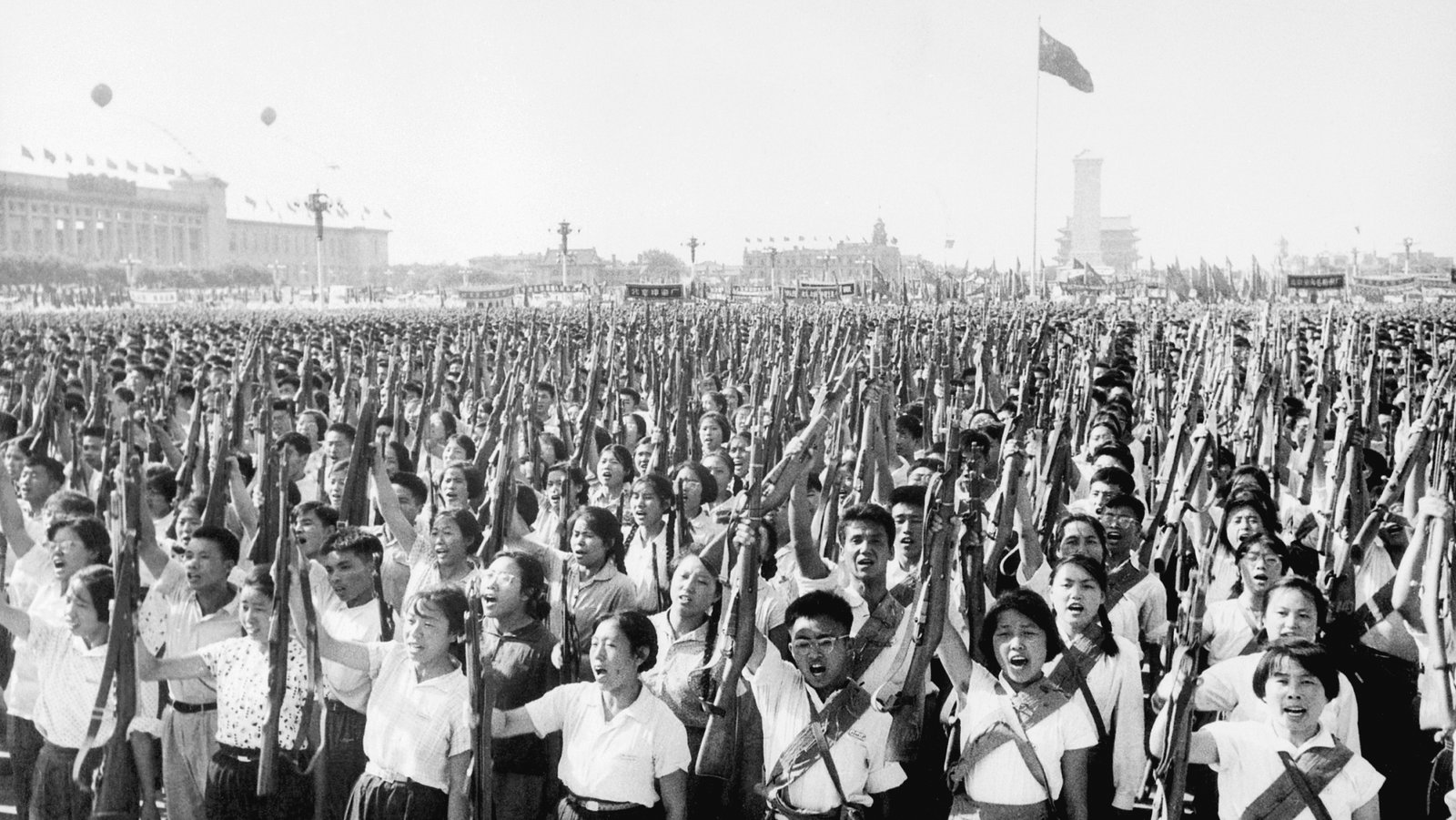
Still, in some peculiar ways, the two distinct positions of China and the Soviet Union supplemented each other on the ground during the 1960s. While China’s Cultural Revolution and Vietnam’s armed struggle provided a new revolutionary spirit, the Soviet Union was the necessary nuclear military power that could counterbalance U.S. imperialism on a global scale, so that the revolutionary spirit could receive the necessary space to flourish without being crushed. The Soviet Union’s ability to reciprocate a nuclear attack prevented the outbreak of a devastating global nuclear war and deterred the U.S. from using nuclear weapons in its imperialist wars. Vietnam took advantage of “the best of both worlds.” The Soviet Union provided them with anti-aircraft missiles and heavy artillery alongside existential guarantees to counterbalance the U.S. and avoid a nuclear attack on Hanoi. At the same time, Vietnam waged a “protracted people’s war” on the ground without compromise, until its final victory, in tune with Maoist military strategy.
During the Cultural Revolution the concept of “Mao Zedong Thought” was established as the yardstick with which one could and must measure political correctness in China. Mao Zedong Thought was concentrated in The Little Red Book: Quotations from Chairman Mao Zedong, published in 1964, first to be used in the army, but it quickly spread to the entire society. The book gained enormous influence. In 1966, it was translated and sold in over a hundred countries. Over one billion official volumes were sold between 1966 and 1969 alone.[74] It was Lin Biao who coined the term “Mao Zedong Thought” as a tendency of Marxism, in the same way that Stalin coined “Leninism.”
Lin’s transformation of Mao’s writings on specific matters into universal truth also had an international dimension. Stressing Mao Zedong Thought as a development of Marxism is correct if what is meant is that Mao’s application of the Marxist method demonstrates how reality can be studied and acted upon. The Vietnamese applied the Maoist guerrilla strategy and people’s protracted war with great success. However, the use of Mao Zedong Thought becomes wrong if it is thereby meant that Mao’s specific judgments on concrete international and Chinese situations and phenomena, at certain moments, can be applied as if they were of universal validity. This was the approach being taken in China, to some extent, and by many Maoists around the world in the 1970s. These Maoist organizations treated Mao’s specific analyses as universal laws and applied them to situations that did not necessarily conform to those in which they were developed.
The copy-pasting of Maoism became grotesque when it was transferred to the imperialist heartland. In late 1966, the Chinese press, which hitherto had been almost silent about the working classes of the imperialist countries, began writing about the poor, exploited Western workers who were awakening to the revolutionary struggle against their oppressors. Mass rallies were held in support of white American workers’ purely economic strike actions, and British dockworkers were praised for their heroic struggle against ruthless exploitation.[75] Even more peculiarly, Maoist groups in North America and Europe talked about the peasants, fishermen, and workers in the same manner as Mao did with these classes in 1930s China.
There are similarities between the Chinese attitude in the late 1960s and the former Soviet Communist Party in the 1930s. China had taken over the position occupied by the Soviet Union in the world as the “native country of socialism.” When Lenin, in the last years of his life, assessed perspectives on the future of socialism in the Soviet Union, he stressed that the decisive problem was whether Soviet power could hold out until the proletariat in more advanced countries accomplished their revolution. From this perspective, he concluded that the Bolsheviks had to do everything within their power to maintain workers’ power until the European working class completed its revolution. In the 1930s, the COMINTERN interpreted this to mean that the most important task for all communists was to preserve the power of Soviet workers. For a Marxist, the “touchstone” was one’s attitude toward the Soviet Union.
The Chinese took over this position: the “touchstone” for a Marxist became their attitude toward China, specifically toward the Cultural Revolution, and Mao Zedong Thought, while China was awaiting the proletariat in the Third World to follow their path to socialism. Nevertheless, this thesis was just as incorrect when applied to China as it was to the Soviet Union. For Marxists, the “touchstone” was the ability to develop a revolutionary theory based on the specific circumstances of their own country and its position in the capitalist world system. This was what qualified Mao during the period when the COMINTERN and Stalin had quite different theories for the Chinese Revolution. Mao stressed that being a Marxist in China meant knowing, understanding, and correctly influencing Chinese reality. The term “Mao Zedong Thought” was used during the Cultural Revolution in a manner similar to the Soviet use of the term “Leninism” under Stalin. In order to secure the victory of the Chinese Revolution, Mao Zedong had to directly oppose this “Leninism.”
“Leninism” and “Mao Zedong Thought” correspond to two different stages in the worldwide development of socialism. However, China in the 1970s, just like the Soviet Union at the beginning of the 1920s, was facing the problem of whether it could “hold out” until the tide of revolutionary movements might materialize into socialist countries around the world. Just as Lenin’s hopes were in vain, so too were the hopes of the Chinese. The national liberation struggles in the Third World during “the long sixties” did not proceed into a socialist world revolution. Global capitalism had not yet exhausted its development opportunities.
The reason why the Cultural Revolution did not materialize into a socialist economic development has both an internal Chinese explanation and a global explanation. China had to change its course.
It was not only the Cultural Revolution that lost its steam through the 1970s, but it was also revolutionary movements all over the world. This indicates that there was a deeper transformation occurring in world capitalism, which was reflected in global class struggles. National self-determination and the ambition to create socialism were not enough to bring about socialism in reality. The conditions were even more difficult for the smaller Third World countries than it had been for huge countries like Russia and China —particularly in terms of economic diversity and mounting a defence against hostile imperialist encirclement.
Mao’s Cultural Revolution also had a global perspective. The various national liberation struggles by the people around the world would contribute to the battle of the revolutionary “countryside” against the “imperialist cities.” China should be at the center of this process as the guide of the anti-imperialist struggle worldwide. This struggle would weaken U.S. imperialism and deter it from the accomplishment of its goal, i.e., the destruction of the Chinese Revolution.
Most important, however, was the polarizing dynamic, caused by imperialism. Raw material and agricultural products produced by low-wage labor in the Third World were exchanged by industrial products produced by relatively high-wage labor in the imperialist center. The newborn revolutionary states did not have the power to change these dynamics. They could not simply increase wages and prices for the raw materials and agricultural products they supplied to the world market. Without the necessary development and diversity of the productive forces, delinking themselves from the world market and trying to produce solely for the domestic market in the interest of the workers and peasants risking throwing their economies into ruin. No matter their aspirations, the economies of the newly independent countries were determined by the dominant capitalist realities.
The rise of neoliberal globalization
In the late 70s, it became clear that the Third World was not able to continue national liberation into an economic liberation from imperialism. Furthermore, the bloc of transitional states disintegrated as a consequence of the Sino-Soviet split, which accelerated as China labeled the Soviets “the most dangerous socialist imperialist power.”[76]The split spread into Third World movements and communist parties around the world. In the Soviet Union the economy began to stagnate in the 70s, and the Communist Party did not have the capability to innovate and find a new political course to advance socialism.
The other aspect in the principal contradiction –U.S. neo-colonialism– was also under transformation. As it turned out, capitalism had the potential for yet another round in the ring. It launched a new offensive from the end of the 1970s through neoliberal reforms and the globalization of the production process itself by basing it on low-paid labor in the South. It triggered the rapid development of the productive forces, both qualitatively (computers, communications, new transnational management regimes and container transports) and quantitatively, by industrializing the Third World, integrating hundreds of millions of new proletarians into the world economy.
China’s response to neoliberal globalization
In China, the Cultural Revolution came to an end, and so was hope that socialist revolutions in the Third World would spread and create a new socialist bloc that could pull China out of its isolation. China did not have the political force. There was no Maoist COMINTERN to coordinate the struggle, and –China at the time– did not have the economic, political, and military power to be the driver of such a process. The revolutionary spirit of the sixties was not enough to defeat a still vital and politically and militarily strong capitalism. The world revolution was not on the agenda. China was therefore left with the question of how to proceed. Again, analogous to how the Soviet Union in the 1930s had changed strategy from promoting world revolution to socialism in one country, China’s strategy became to focus on the development of “socialism with Chinese characteristics.” For this, China needed access to new technological developments.
This marked a profound change in China’s foreign policy. The first step was establishing contact with the U.S. During the latter years of Mao’s rule, first Henry Kissinger in 1971 and then Nixon the following year were invited to Beijing. The U.S., for its part, used the opening to China to focus on confronting the Soviet Union.
Over the following years, China developed a strategy based on an analysis of the world-system known as the “Three Worlds Theory.” During a conversation with Zambian President Kenneth Kaunda in 1974, Mao defined the “Three Worlds” as follows:
I hold that the U.S. and the Soviet Union belong to the First World. The middle elements, such as Japan, Europe, Australia and Canada, belong to the Second World. We are the Third World.[77]
According to this theory, the two superpowers, the U.S. and the Soviet Union, were fighting for world domination. In that confrontation, China declared that the Soviet Union was the aggressive part. The Soviet Union was no longer just “revisionist,” it was also “social imperialist.” The situation was so dire that the Third World had to side with the Second World in supporting the U.S. in its fight against “Soviet imperialism.” However, was the Soviet Union “the most dangerous imperialist power” in in the mid-1970s? There is no empirical evidence suggesting that the Soviet Union relied on imperialist exploitation to sustain its economy. In fact, the Soviets supported many Third World countries and remaining liberation struggles in, for example, South Africa, Palestine, and Nicaragua in the late ’70s and into the ’80s.
The “Three Worlds Theory” led China to support anti-Soviet movements in the Third World, for example FNLA in the Angolan civil war, which were backed by Zaire, Apartheid South Africa, and the U.S. against the MPLA supported by the Soviets and Cuba. China also fought a brief war with Vietnam, a close ally of the Soviet Union, in 1979. I would argue that China’s ideological and national contradictions with the Soviet Union, led to an incorrect perception of the principal contradiction within the world-system at that time.
Mao died in 1976. During the following years, the “Three World Theory” slipped into the background of Chinese foreign policy as the economic and political crises in the Soviet Union deepened and neoliberalism gained force. With the comeback of Deng Xiaoping in 1978 –whose reputation had been degraded during the Cultural Revolution– China began to develop a strategy based on the new principal contradiction in world-system: neoliberal globalization versus the national state.
It might seem strange that Deng Xiaoping’s “opening up” to transnational capital was a suitable way forward for a transitional state, however, given the prevalent trends of the world-system at the time, China saw it as the best way forward to develop their productive forces to be able to defend and develop its national project.
China’s encounter with neoliberalism was very different from that of the Soviet Union and the rest of Asia, Africa, and Latin America. The Soviet Union was dissolved and exposed to neoliberal shock therapy during Yeltsin’s rule, which had a devastating effect on the economy. In Asia, Africa, and Latin America, “structural adjustments” forced countries to open their economies to exploitation by transnational companies. In contrast to this, China managed to keep its national project –socialism with Chinese characteristics– intact. Deng Xiaoping’s administration pursued a “kung fu” strategy toward neoliberalism: bending to the pressure of the capitalist offensive without breaking the power of the Communist Party. Thus, China could use the dynamic power of neoliberalism against itself by allowing it to develop the country’s productive forces. Politics were in command of economics. China had the organizational, social, and political capability to use the transfer of advanced technology to develop the prerequisites for moving towards socialism.
The rise of China
China’s national project became a challenge to U.S. hegemony. On the one hand, as a result of neoliberal globalization, there was an increased transfer of value to the North; on the other hand, it led to the immense development of the productive forces, enabling the country to begin to turn the tables on the prevailing economic system. In its eagerness to maximize profit by outsourcing industrial production to low-wage countries, transnational capital transferred technology and knowledge to China. The rise of China as the world’s leading industrial power has broken the polarizing dynamic between center and periphery for the first time in two hundred years.
From 1979 to 2018, the average annual rate of China’s economic growth was 9.5%, described by the World Bank as “the fastest sustained expansion by a major economy in history.”[78] China became the world’s leading industrial producer during the era of neoliberal globalization. However, the financial crisis in 2007-8 was a wake-up call for the Chinese leadership and led them to realize that neoliberalism was no longer a dynamic force to develop the productive forces, but increasingly a cause of problems such as economic stagnation, social inequality, and environmental issues.
Chinese policy has shifted from “let some people get rich first” to “common prosperity,” prioritizing the eradication of absolute poverty in rural areas. China has changed its economic strategy from relying on exports to the Global North to, instead, prioritizing South-South trade, while expanding its domestic market. These changes have created an increasing discordance between China’s national development project and global capitalism.
The success of Deng Xiaoping’s policy of “Reform and Opening Up” to transnational capital was built on the previous forty years of development under Mao’s leadership, which to a large extent was driven by the revolutionary spirit. Deng’s policy has changed the world by breaking the economic superiority of the West. However, decades of “opening up” to transnational capital were not without danger or consequence, as indicated by the Tiananmen Square protests in 1989 and the spread of neoliberal values and norms in China. Since 2012, Xi Jinping’s tenure has been referred to as a “New Era” and has marked a significant change in policy. In some ways, it has taken the form of “cleaning up” after neoliberalism in the Communist Party and wider society.
The transitional mode of production
China has developed a transitional mode of production still existing in a world economy dominated by capitalism and its law of value. It is governed by a transitional state, which also exists in a dominant capitalist world-system, politically and militarily.
The ability of China’s transitional state to break a century of polarizing dynamics in capitalism and, for the first time, develop a transitional mode of production superior to capitalism in the imperial core is the result of political governance of economic development throughout the history of the People’s Republic of China. The Communist Party and state institutions have used their political power to establish goals, determine strategies, and organize sectors and ownership for the development of science, technology, and industry. The capitalist sector –both domestic and foreign capital– plays an important role in technological innovation in the high-tech sector; however, this role is subject to political decisions made by the Communist Party regarding the planning, production, and diffusion of technology.[79]
The land reform and emphasis on expanding agricultural production to make China self-sufficient in food production were accompanied by an effort to industrialize. The planned economy aimed to coordinate the entire process, from the scientific research and innovation system –composed of industrial research departments and universities– to the development of prototypes and final production. From resource input to the innovation process, everything was carried out in accordance with the central plan. This was an institutional mechanism that “concentrates power to do great things,” which often referred to the unique capabilities of the socialist system.[80]
In the 1970s, an overall, comprehensive industrial base was established.[81] Prioritizing expanded reproduction due to national strategy to focus on heavy industries, the production of consumer goods such as televisions and cars, lagged behind. More importantly the emerging industrial sectors such as cell phones, personal computers, integrated circuits, and software, were underdeveloped.
From the late 1970s, and over the next three decades, a historically significant transformation of the international division of labor occurred. Based on the development of the productive forces, the still dynamic capitalist mode of production, launched neoliberal globalization. The economic and political force of this offensive penetrated deep into the transitional states. China opened itself up to transnational capital inflows and expanded the role of the capitalist sector and capitalist market mechanisms. Many state-owned industries became joint ventures with Western multinational companies to gain access to the global market, as well as the latest technology and management systems.
Quantitatively speaking, opening up meant a huge development of the productive forces in China, driven by the exports to the world market. China became the factory of the world in a few decades. However, the results concerning the qualitative side of development of the productive forces were initially less positive. Foreign transnational companies were not interested in sharing their technological knowledge. Their primary interest was using low-wage Chinese labor in the global value chain.
Around the crisis of neoliberalism in 2007/8, the Communist Party of China changed its strategy. The transitional state was able to do so because it maintained control over the central features of the economy. Capitalism had not escaped the “political cage” during the opening up. While the capitalist world-system went into recession, China was able to move forward.
China began shifting the cycle of capital accumulation away from focusing on exports to North America and the EU, and toward domestic circulation and South-South trade. By tripling the wage level in industry in a decade and investing heavily in the poorest rural areas, hundreds of millions were pulled out of poverty. By reducing the value transfer through unequal exchange between the Global South and North within the world-system and significantly raising the living standards of workers and peasants in China, a transitional state broke centuries of polarizing tendency within global capitalism.
The current principal contradiction
In the 1970s the Third World demanded another world order, but the revolutionary spirit proved insufficient, in the face of the pushback from capitalist market forces, to meet this aspiration. Today the Global South, with China at the forefront, is building another world order. In the 1970s, the ruling class was able to launch a potent counter offensive in the form of neoliberal globalization. Today the ruling class is bewildered; they cannot rule in the old manner anymore. The U.S. remains a dangerous hegemon in the military sense, but the Global South is on the offensive on the economic front. While the transformative power of the Third World in the 1970s was based on the “revolutionary spirit” –an attempt at ideological dominance over economic development– the current transformative power of the Global South is based on its economic strength.
The crises of neoliberal globalization and the demand for greater national control of market forces have transformed the principal contradiction. The aspect of transnational capital has been weakened, and the aspect of the national state has been strengthened. The U.S. is the major exponent of the power of transnational capital, with the EU and Japan as junior partners, and China is the major exponent of the project of national development controlled by political power. Thus, we can formulate the current principal contradiction as this: The decline of U.S. hegemony versus the rise of China, and the development of a multipolar world order.
China’s strategy for a multipolar world
The negative consequences of neoliberalism have led to a reemerging Marxist critique of capitalism in China, challenging the influence of neoliberal thought. When Xi Jinping came to power in 2012, he started an anti-corruption campaign, fighting the cronyism that had resulted from neoliberalism’s entry in China’s economy. Xi also initiated policies within the Communist Party itself to ensure that capitalists in China should not be allowed to become a class in the political sense. Decades of “opening up” to neoliberalism have left their mark, not only in terms of increased inequality, but also in terms of worse working conditions, especially for the workers in export zones. The values and norms of neoliberalism have also left their mark: individualism, a mentality of competitiveness, along with greed, have made their inroads at the expense of solidarity and community. Xi’s policies are also intended to curb the greedy nature of capitalists and the chronic problems of rising (consumerist) materialism. The new political line also emphasizes ecological balance and rural revitalization, and the forging of a “dual circulation” with increasing emphasis on the domestic market alongside South-South trade —all of these designed to reduce China’s dependence on the North American and European markets.
In 2013, Xi launched the “Belt and Road Initiative” which involved building train lines, roads, ports, and airports and other infrastructure to connect South and Central Asia to the Middle East and Europe. This is coupled with a Maritime Silk Road that would connect China to Southeast Asia, West Asia, Africa, and Europe via various sea lanes. In 2017, China further extended its Maritime Silk Road to South America. This project, in combination with the intergovernmental organization BRICS+, ultimately involves shifting power away from the U.S./EU/Japan dominated North-South hierarchy, towards a South-South economic cooperation and a multipolar political world-system.
The experience of history therefore suggests the struggle for socialism in the world-system can be seen as a multi-step sequence: the first step is the communist movement taking state power. Then, the establishment of a transitional state that tries to develop the productive forces necessary for the transition to socialism, while at the same time struggling for survival in a world-system dominated by capitalism.
Part of that struggle involves the transitional state attempting to organize a multipolar world in opposition to the hegemonic imperialist power. One can present this as an analogy between China’s policy of “New Democracy” when the People’s Republic was established in 1949 –uniting “the working class, the peasantry, the urban petty bourgeoisie, and the national bourgeoisie” to “enforce their dictatorship over the running dogs of imperialism”[82]– and the current alliance between transitional, socialist-orientated states and nationalist capitalist states in the Global South. BRICS+ is not an anti-capitalist organization, but all member countries are tired of centuries of Western dominance.
The global trade pattern is under transformation. After more than a hundred years, North-South trade is declining, and South-South trade is on the rise. The global value transfer by unequal exchange from South to North has begun to decline for the first time in the past 150 years. The transformation in trade structures is accompanied by changes in finance and banking in the world-system. Alternatives to the Bretton Woods institutions –such as the World Bank and IMF– are being developed in the context of BRICS+. This gives the Global South possibilities to invest and trade in their own currencies instead of dollars, and to lend money without demands for “structural adjustments” and other political conditions. States in the Global South are gaining economic space and thereby possibilities to adopt an anti-imperialist standpoint.
However, the driving force behind what happens at state level is class struggle. We must understand the dialectical relationship between emerging multipolarity and class struggle, both in the transitional states itself, and the class struggle in the conservative capitalist nationalist regimes in the Global South. To reject that national capitalist states –even the conservative ones– in the Global South have a progressive part to play in the struggle against U.S. unipolarity is to fail to consider the reality in the world-system. The struggle against imperialism must be fought at the state level and at the level of the movements in combination. To develop a strategy in the complex pattern of contradictions, we must stick to the importance of the concept of the principal contradiction, as the point of departure of the analysis, but not neglect the feedback of the regional, national, and local contradictions.
The realization of the transformation from capitalism towards socialism depends significantly on how China is able to manage multipolarity. Currently, the People’s Republic of China has a strict policy of non-interference in other countries’ internal affairs, reflected in its foreign policy at state level. At the same time, the Communist Party of China has relations with communists, socialists, and progressive nationalist movements participating in class struggle both in the Global South and North. The balance between those positions is delicate and can change both as the struggle between the U.S.-led West and Global South deepens, and class struggles in the capitalist states in the Global North and South evolves.
The transformation towards socialism on national and global levels
The dialectic of the transitional state is represented by, respectively, the nationalist development perspective and a universal socialist perspective, present in Mao’s thinking from the very beginning of the Communist Party of China. Although Communists pursue world revolution, the transformation process must go through the national state as constituted within the historical framework.
On January 30, 1962, Mao envisioned the timeframe for the transition to socialism in China:
I took from three to four hundred years to build a great and mighty capitalist economy; what would be wrong with building a great and mighty socialist economy in our country in about fifty or hundred years? The next fifty or hundred years from now will be an epic period of fundamental change in the social system of the world, an earth-shaking period, with which no past era can be compared. Living in such a period, we must be prepared to carry out great struggles, differing in many respects from the forms of struggles of previous periods. In order to carry out this task, we must do our very best to combine the universal truth of Marxism-Leninism with the concrete reality of Chinese socialist construction and with the reality of future world revolution and, through practice, gradually come to understand the objective laws of the struggle. We must be prepared to suffer many defeats and setbacks as a result of our blindness, thereby gaining experience and winning final victory. When we see things in this light, then there are many advantages in envisaging it taking a long period; conversely, harm would result from envisaging a short period.[83]
China currently argues that it is in the primary stage of socialism, and that “basic realization” will not be achieved until around 2035 and “full realization” will not be achieved until 2050.[84]
During this period China, or any other transitional state, is in economic and political contact with other capitalist states, as the interaction with global capitalism is part of the transition process. This modifies capitalism and presents itself as an alternative to it. China must advance toward socialism on its own national path –“socialism with Chinese characteristics”– while bearing in mind that a developed socialist mode of production has to be realized on the global level: this is because global socialism has to solve the historically inherited problem of inequality between the center and the periphery in the world-system, as well as the global ecological and climate problems.
As we advance toward a more developed stage of socialism, different forms of socialism will emerge, each with its own national characteristics based on distinct histories and cultures. In this process it is important to maintain a balance between national interests and the requirements of a socialist transformation of the world-system. Historically, this has been a problem. Nationalist disputes between transitional states in a multipolar world will not only benefit remaining imperialism but will also increase the risk of nuclear warfare and slow down solutions to the urgent environmental and climate problems. This will impede the transition toward advanced global socialism.
The transitional state and the world revolution
Today, conventionally, we think of the transition from capitalism to socialism within a national framework, although both Marx, and later Lenin, were aware that socialism could only be realized as a world-system —or at least a significant part of the world.
Over the past two centuries, the capitalist mode of production has created an international division of labor that has polarized the world into rich and poor countries. Internationally, a politically decided planning of either the division of labor or the distribution of products has never existed. Transitional states that have adopted a planned economy still present themselves internationally as independent bargaining partners, like any other capitalist entity.[85]
However, the fact that, up to the present time, the international market and its global law of value have always conditioned the international division of labor and the distribution of the outputs should not be sufficient in itself for reaching the conclusion that things could not be otherwise. One can easily imagine a socialist world plan that centrally implements the division of labor and distribution of production on a planetary scale.[86] In fact, this will be necessary to solve the planet’s ecological and social problems.
Humanity has transitioned from scattered local communities to states and empires, moving towards an increasingly globalized world-system equipped with advanced productive forces. However, along the way, we have developed a lifestyle that has damaged the planet and acquired weapons capable of destroying all human life. We have also contributed to the knowledge and ability to organize and manage the world-system as a whole, which is necessary for an advanced mode of social production.[87] Globalization itself is not to blame for the inequality and destruction of the planet earth’s ecology and climate; rather, it is the globalization of capitalism under U.S. hegemony that is responsible. In the transition to socialism, the national framework constitutes a historical constraint that must be accepted as a necessity rather than a virtue.
Transforming the relations of production toward socialism does not mean reverting to productive forces organized solely within a national framework. World unification is no longer optional; it is a condition of our future existence.
So, in order to move onwards to an advanced socialist mode of production, we need, in addition to the “national characteristics of socialism,” to develop the universal and global dimensions of socialism. At the international level, investment and trade should promote global equality and ecological sustainability. A global planned economy has to be introduced and managed by global political institutions. Emmanuel did not believe in equalization in the world within the capitalist mode of production:
Under no circumstances can all of the [developing nations] become the United States, assuming that they want to. The United States is only the United States because the others are not. The level of development they have arranged considerably exceeds the global margins of the capitalist system worldwide: they are, in capitalist terms, overdeveloped. Naturally, they can only be overdeveloped because there are sufficient exploitable underdeveloped areas around them. It may still be possible to achieve this accelerated ‘extroverted’ development in a particular small country, if the little international capital available is concentrated there. This will be because the others will not follow suit. For the whole of the Third World, such an attempt would be, apart from any value judgment, materially futile. The only way left to it is to set fire to the capitalist stage.[88]
Emmanuel also did not believe that it is possible to develop an advanced form of socialism at the national level, or “socialism in one country.” Socialism must be global. In a letter to Samir Amin, he wrote:
It is too often forgotten that this is a completely new situation from the point of view of revolutionary Marxism. When we spoke of socialism in several countries, no one had ever imagined the existence of several socialisms-in-one-country. Stalin himself conceived (at least before the last war) socialism in one country only for the first socialist country and waiting for the revolution to be made in other countries.
Nevertheless, if we consider the nation as a constraining reality that socialism itself cannot overcome and that it will take several generations to do so, I agree with you that the only way to unify the world is to first equalize the national levels through self-centered developments. But it certainly does not escape you that these ‘self-centred developments’ will be to the detriment of the world optimum and cannot be done without friction. This shows once again that the national fact, which the Marxists had seriously underestimated, constitutes a source of contradictions in the world which the class struggle does not automatically resolve.[89]
As the Indian political economist Aritro Ghosh writes:
Capitalism is a world-system and not an aggregation of national economies. A poor country will still be exploited by unequal terms in trade after a socialist revolution and the only way to break out of it is a third-world revolution whereby the whole swathe of poor countries forms a common union amongst themselves.[90]
To realize an advanced socialist mode of production requires not only that China move in that direction but also that the majority of states in the world-system join the effort. In the coming decades, we might see the development of different socialisms with national characteristics, based on different histories and cultures. However, it is essential to transition from a nationalist perspective to a global socialist one. The nationalist perspective contains elements that could lead to future national disputes, which would only benefit remaining capitalist elements. This perspective also increases the risk of nuclear warfare and hinders progress in solving urgent environmental and climate problems.
Hickel and his colleagues wrote in the conclusion of their study on the size of unequal exchange in 2023:
Development and poverty eradication, and any plausible trajectory for reducing global inequality, requires a shift in the balance of power between North and South, such that the latter is able to reclaim its productive capacities to meet human needs.
Toward this end, international wage floors and minimum resource prices could help reduce price inequalities and limit value transfers. Ending unequal exchange will also require ending structural adjustment conditions on finance, and democratizing the institutions of global economic governance, so that Global South governments are free to use industrial, fiscal and monetary policy to pursue sovereign development and reduce their dependency on Northern capital. Such reforms are unlikely to be handed down from above, however. It will require a political struggle for national self-determination and economic sovereignty similar in scope to the anti-colonial movement of the 20th century.[91]
Capitalism, once a dynamic developer of the productive forces, has today become an obstacle to development. As the U.S. has lost its economic superiority, it has turned to economic, political, and military warfare. In doing so, it has eroded the very world market and political institutions that served it well for half a century. This is a desperate attempt to avoid losing its hegemonic position.
The periphery today is in a better position to move ahead in economic liberation from imperialism than the Third World was during the Long Sixties. At the time, it was “the revolutionary spirit” –the “will”– which was the driver of national liberation. The industrialization of the Global South over the past few decades has created thematerial possibilities for progress towards socialism. China, a former peripheral state, has managed to break the polarizing dynamic of global capitalism and developed its productive forces to an advanced stage. The world-system is transitioning from unipolarity to multipolarity, which weakens capitalism’s economic and political dominance. Today, China is one of the aspects in the current principal contradiction, with the ability to more directly determine its own development and influence the fate of humanity and the global ecosystem.
As we approach this revolutionary “endgame” of capitalism, the class struggle between the proletariat and the bourgeoisie will intensify at both the national and global levels. In assessing the global threat levels of his time, Mao famously called imperialism a “paper tiger:”
Imperialism and all reactionaries looked at in essence, from a long-term point of view, from a strategic point of view, must be seen for what they are —paper tigers. On this, we should build our strategic thinking. On the other hand, they are also living tigers, iron tigers, real tigers that can devour people. On this, we should build our tactical thinking.[92]
We must be careful and avoid adventurous actions because global nuclear war would be catastrophic. However, we cannot allow ourselves to give in to imperialist threats either.
The hope is that the decline of U.S. hegemony will also mean the decline of the capitalist mode of production. And that the rising multipolar world-system will move toward socialism with different national characteristics. Today, after decades of intense neoliberal globalization of the economy, politics, and culture in the world-system, and in light of the urgent need to address global inequality and ecological and climate problems of planet earth, the question of a universal socialist perspective as a strategic goal has reemerged as a precondition for developing an advanced socialism. I believe there is a possibility that the transitional mode of production can generate this new form of globalization to solve these problems before it is too late.
*This essay was written for Textum’s dossier “China: From the ‘Sick Man of the East’ to a Pillar of the Sick System.” Please click here to read the Turkish translation by Halil Can İnce.
[1] V. I. Lenin, Collected Works, vol. 27 (Moscow: Progress Publishers, 1972), 85–158.
[2] Leften Stavros Stavrianos, Global Rift: The Third World Comes of Age (New York: William Morrow & Co., 1981), 492.
[3] Jane Degras, ed., The Communist International, 1919–1943: Selected Documents, vol. 1, 1919–1922 (Oxford: Oxford University Press, 1956), 18.
[4] Leon Trotsky, Manifesto of the Communist International to the Proletariat of the Entire World (March 6, 1919), https://soviethistory.msu.edu/1921/comintern/comintern-texts/manifesto-of-the-communist-international/
[5] Suliman Bashear, Communism in the Arab East, 1918–28 (London: Ithaca Press, 1980), 13.
[6] Ibid., 14.
[7] Frederik Petersson, “‘We Are Neither Visionaries nor Utopian Dreamers’: Willi Münzenberg, the League Against Imperialism, and the COMINTERN, 1925–1933” (PhD diss., Queenston Press, 2013), 28.
[8] V. I. Lenin, “Report of the Commission on the National and Colonial Questions,” in Collected Works, vol. 31 (Moscow: Progress Publishers, 1966), 213–263.
[9] Michael Weiner, “COMINTERN in East Asia, 1919–1939,” in The COMINTERN: A History of International Communism from Lenin to Stalin, ed. Kevin McDermott and Jeremy Agnew (London: Macmillan, 1996), 162.
[10] Anthony Cave Brown and Charles MacDonald, On a Field of Red: The Communist International and the Coming of World War II(London: G. P. Putnam’s Sons, 1981), 189.
[11] Jean Lacouture, Ho Chi Minh: A Political Biography (New York: Vintage, 1968), 41.
[12] Frederik Petersson, “Imperialism and the COMINTERN,” Journal of Labor and Society 20, no. 1 (March 2017): 34.
[13] Frederik Petersson, “‘We Are Neither Visionaries nor Utopian Dreamers’: Willi Münzenberg, the League Against Imperialism, and the COMINTERN, 1925–1933” (PhD diss., Queenston Press, 2013), 136.
[14] Ibid., 137.
[15] Jane Degras, ed., The Communist International, 1919–1943: Documents, vol. 2, 1923–1928 (London: Oxford University Press, 1960), 526–548.
[16] Ibid., 526, 537–547.
[17] Neil Redfern, “The COMINTERN and Imperialism,” Journal of Labor and Society 20, no. 1 (March 2017): 13.
[18] Georgi Dimitrov, Report to the 7th Congress of the Communist International, 1935: For the Unity of the Working Class against Fascism(Red Star Press, 1973), 59.
[19] Neil Redfern, “The COMINTERN and Imperialism,” Journal of Labor and Society 20, no. 1 (March 2017): 56.
[20] Mao Zedong, “The Chinese Revolution and the Communist Party of China,” in Selected Works, vol. 2 (Peking: Foreign Languages Press, 1967), 310.
[21] Maurice Meisner, Li Ta-chao and the Origins of Chinese Marxism (Cambridge, MA: Harvard University Press, 1967), xii.
[22] Ibid., 71-72.
[23] Ibid., 82.
[24] Ibid., 84, 86.
[25] Ibid., 91-93.
[26] Li Dazhao, quoted in Maurice Meisner, Li Ta-chao and the Origins of Chinese Marxism (Cambridge, MA: Harvard University Press, 1967), 150–153.
[27] Patrick Fuliang Shan, Li Dazhao: China’s First Communist, SUNY Series in Chinese Philosophy and Culture (Albany: State University of New York Press, 2024), 146.
[28] Ibid., 163-164.
[29] Meisner, Li Ta-chao and the Origins of Chinese Marxism, 220.
[30] Tony Saich, “Background to the 7 February Peking-Hankou Railway Workers’ Strike,” Chinese Sociology & Anthropology 25, no. 2 (1992): 1–14.
[31] Meisner, Li Ta-chao and the Origins of Chinese Marxism, 237–250.
[32] Ibid., 248.
[33] Ibid., 249, 252.
[34] Mao Zedong, “Report on an Investigation of the Peasant Movement in Hunan,” in Selected Works, vol. 1 (Peking: Foreign Languages Press, 1969).
[35] Mao’s class analysis and strategy in the “Hunan Report” —building a base of power in the villages and, through “long-term people’s war,” “surrounding the cities from the countryside”— has since been taken up, with mixed success, by communist organizations around the world: the NLF (Viet Cong) in Vietnam, communists in Indonesia, Naxalites in India, communists in Nepal, the Philippines and Thailand, MPLA in Angola, FRELIMO in Mozambique, ZANU/ZAPU in Zimbabwe, PAIGC in Guinea-Bissau, the Shining Path in Peru, and even the Black Panther Party in the United States. It is problematic to copy and paste a very specific Chinese analysis across different times and spaces.
[36] Li Yongpu and Lin Zhili, eds., Zhongguo gongchandang lishi, 1919–1949 [History of the Communist Party of China, 1919–1949], vol. 1 (Beijing: People’s Press, 1991), 216.
[37] Shan, Li Dazhao, 195.
[38] Ibid., 202–203.
[39] Meisner, Li Ta-chao and the Origins of Chinese Marxism, xii, 259.
[40] Mao Tse-tung, Selected Military Writings of Mao Tse-tung (Peking: Foreign Languages Press, 1972).
[41] Stuart R. Schram, introduction to Mao Tse-tung, Basic Tactics (New York: Frederick A. Praeger Publishers, 1966), 13.
[42] J. Sakai, The “Dangerous Class” and Revolutionary Theory: Thoughts on the Making of the Lumpen/Proletariat (Montreal: Kersplebedeb, 2017), 22.
[43] Mao Zedong, “Analysis of the Classes in Chinese Society” (1926), in Selected Works, vol. 1 (Peking: Foreign Languages Press, 1969), 19.
[44] Edgar Snow, Red Star over China (New York: Grove Press, 1994), 83.
[45] Mao Tse-tung, “Why Is It That Red Political Power Can Exist in China?” (1928), in Selected Works, vol. 1 (Peking: Foreign Languages Press, 1969), 67.
[46] Mao Tse-tung, “Problems of War and Strategy” (1938), in Selected Works, vol. 2 (Peking: Foreign Languages Press, 1969), 224.
[47] Mao Zedong, quoted in Stephen Uhalley, Mao Zedong: A Critical Biography (New York: New Viewpoints Publishing, 1975).
[48] Mao Zedong, “A Single Spark Can Start a Prairie Fire” (1930), in Selected Works, vol. 1 (Peking: Foreign Languages Press, 1969), 124.
[49] Schram, introduction to Mao Tse-tung, Basic Tactics, 32.
[50] Sun Tzu, The Art of War, trans. Samuel B. Griffith (New York: Oxford University Press, 1963), 106.
[51] Snow, Red Star over China, 262.
[52] Ibid., 160.
[53] William Whitson and Huang Chen-hsia, The Chinese High Command: A History of Communist Military Politics, 1927–71 (New York: Praeger, 1973), 57–58.
[54] Jen-min Ch’u-pan-she, Reminiscences of the Struggle on the Chingkangshan (Peking, 1956), 11, quoted in Schram, introduction to Mao Tse-tung, Basic Tactics, 21–22.
[55] Barbara Barnouin and Yu Changgen, Zhou Enlai: A Political Life (Hong Kong: Chinese University of Hong Kong Press, 2006), 58.
[56] Ibid., 60-61
[57] Mao Zedong, “Summary of a Talk with the Representatives of Press and Publishing Circles” (March 10, 1957), in The Secret Speeches of Chairman Mao: From the Hundred Flowers to the Great Leap Forward, ed. Roderick MacFarquhar, Timothy Cheek, and Eugene Wu, Harvard Contemporary China Series 6 (Cambridge, MA: Harvard University Press, 1989), 255.
[58] Actually, the Chinese signs for “socialism with Chinese characteristics” reads directly translated: “Chinese characteristics of Socialism” (Xu Zhun at a symposium in Bern March 14th, 2026, arranged by the journal Socialism and Democracy.)
[59] Mao Zedong, “The Role of the Communist Party of China in the National War” (October 1938), in Selected Works, vol. 2, https://www.marxists.org/reference/archive/mao/selected-works/volume-2/mswv2_10.htm
[60] Mao Zedong, “On Contradiction” (1937), part 4, in Selected Works of Mao Tse-tung, vol. 1 (Beijing: Foreign Languages Press, 1969), 311–347.
[61] Ibid., 332.
[62] Roy Neville Singham, The 80th Anniversary of Victory in the World Anti-Fascist War: Understanding Who Saved Humanity—A Restorationist History (Tricontinental: Institute for Social Research, 2025), 35, https://thetricontinental.org/wp-content/uploads/2025/11/20251106_WAFW_EN_Web.pdf
[63] Ibid., 26.
[64] Ibid., 23-24.
[65] Mao Tse-tung, “Why Is It That Red Political Power Can Exist in China?” (1928), note 7, in Selected Works, vol. 1 (Peking: Foreign Languages Press, 1969), 71.
[66] Mao Tse-tung, “Farewell, Leighton Stuart” (1949), in Selected Works of Mao Tse-tung, vol. 4 (Peking: Foreign Languages Press, 1969), 433–434.
[67] Sergei Goncharov, John Lewis, and Xue Litai, Uncertain Partners: Stalin, Mao, and the Korean War (Stanford: Stanford University Press, 1993), 7.
[68] Mao Zedong, “Speech at the Tenth Plenum of the Eighth Central Committee of the CPC” (September 24, 1962), in Chairman Mao Talks to the People: Talks and Letters, 1956–1971 (New York: Pantheon, 1974), 191.
[69] Angus Maddison, Chinese Economic Performance in the Long Run, 960–2030 AD, 2nd ed., rev. and updated (Paris: OECD Development Centre, 2007), 213.
[70] OECD, La science et la technologie en République populaire de Chine (Paris: OECD, 1977), 106.
[71] Mao Tse-tung, “Opening Address at the First Plenary Session of the Chinese People’s Political Consultative Conference” (September 21, 1949), in Selected Works of Mao Tse-tung, vol. 5 (Peking: Foreign Languages Press, 1969).
[72] Wen Tiejun, Ten Crises: The Political Economy of China’s Development, 1949–2020 (London: Macmillan, 2021), 53.
[73] Mao Tse-tung, “The Masses Can Do Anything” (September 29, 1958), interview with a Hsinhua News Agency correspondent, in Selected Works of Mao Tse-tung, vol. 8 (Secunderabad: Kranti Publications, 1994), 132.
[74] Alexander C. Cook, Mao’s Little Red Book: A Global History (Cambridge: Cambridge University Press, 2014), xiii.
[75] “Letter to Central Committee of the Communist Party of China,” https://snylterstaten.dk/letter-to-central-committee-of-the-communist-party-of-china/.
[76] “Soviet Social-Imperialism —Most Dangerous Source of War,” Peking Review, no. 5, January 30, 1976, https://www.marxists.org/subject/china/peking-review/1976/PR1976-05.pdf.
[77] Mao Zedong, “On the Question of the Differentiation of the Three Worlds” (February 22, 1974), excerpts from Mao Zedong’s talk with President Kenneth Kaunda of Zambia, in Mao Zedong on Diplomacy (Beijing: Foreign Languages Press, 1998).
[78] Congressional Research Service, “China’s Economic Rise: History, Trends, Challenges, and Implications for the United States,” https://www.everycrsreport.com/reports/RL33534.html.
[79] Yan Pan, “China’s Path towards Technological and Industrial Self-Reliance” (paper presented at the conference in Amsterdam, January 29–30, 2026), 1.
[80] Jeroen Groenewegen-Lau, Whole-of-Nation Innovation: Does China’s Socialist System Give It an Edge in Science and Technology?(California Institute on Global Conflict and Cooperation and Mercator Institute for China Studies, 2024), https://ucigcc.org/wp-content/uploads/2024/02/Jeroen-Whole-of-Nation-Innovation-10.02.24.pdf.
[81] Pan, “China’s Path towards Technological and Industrial Self-Reliance,” 4.
[82] Mao Tse-tung, “On New Democracy” (1940), in Selected Works, vol. 2 (Beijing: Foreign Languages Press, 1965).
[83] Mao Tse-tung, “Talk at an Enlarged Central Work Conference” (January 30, 1962), quoted in Stuart Schram, ed., Mao Tse-tung Unrehearsed: Talks and Letters, 1956–71 (Harmondsworth: Pelican Books, 1974), 175.
[84] National Development and Reform Commission, “Xi Jinping’s Thought on Economy: A Scientific Theory for Guiding Construction of a Modern Socialist Country,” 2023, https://www.ndrc.gov.cn/xwdt/ztzl/NEW_srxxgcjjpjjsx/yjcg/yw/202401/t20240123_1363634.html
[85] The closest attempt to establish an international planned economy was COMECON during the Soviet period, but it does not seem to have gone very far. See Arghiri Emmanuel, Unequal Exchange Revisited, IDS Discussion Paper no. 77 (Brighton: Institute of Development Studies, University of Sussex, 1975), 4.
[86] Emmanuel, Unequal Exchange Revisited, 4.
[87] Jiang Zhaohui and Zheng Liansheng, “Disorderly Expansion of Capital: Performance, Risks, Root Causes, and Responses,” CSIS Interpret: China, 2022, https://interpret.csis.org/translations/disorderly-expansion-of-capital-performance-risks-root-causes-and-responses/. Originally published in China Development Observation.
[88] Arghiri Emmanuel, “The Multinational Corporations and Inequality of Development,” International Social Science Journal 28, no. 4 (1976): 754–772, 762–763.
[89] Arghiri Emmanuel, “Letter to Samir Amin,” in Arghiri Emmanuel Archive. The letter comments on Samir Amin’s manuscript L’accumulation à l’échelle mondiale, published in 1970; the letter therefore predates the book’s publication. Quotation from p. 7. https://unequalexchange.org/2024/11/30/arghiri-emmanuels-letter-fo-samir-amin/.
[90] Aritro Ghosh, “The Only Way Left to It Is to Set Fire to the Capitalist Stage,” Azaad Substack, February 10, 2025, https://azaaad.substack.com/p/the-only-way-left-to-it-is-to-set.
[91] Jason Hickel, Morena Hanbury Lemos, and Felix Barbour, “Unequal Exchange of Labour in the World Economy,” Nature Communications 15, no. 6298 (2024): 9.
[92] Mao Tse-tung, “Speech at the Wuchang Meeting of the Political Bureau of the Central Committee of the Communist Party of China” (1958), in Selected Works of Mao Tse-tung, vol. 4 (Beijing: Foreign Languages Press, 1958), 98–99, available at https://www.marxists.org.